
Author

Hazel Sloane

Browsing

By Hazel Sloane

Complete German Shepherd growth chart from puppy to adult—average weight, height expectations, and when GSDs stop growing at every age.


When I brought home my first German Shepherd puppy, Luna, at 8 weeks old, she weighed just 16 pounds and fit in my arms. I remember wondering: how big will she actually get? Will she be 60 pounds or 90? When will she stop growing?

Fast forward two years, and Luna weighs a solid 72 pounds—right in the middle of the female German Shepherd range. But getting there wasn’t a straight line. Some months she grew so fast I could barely keep up with her food needs. Other months, growth seemed to stall completely.

Understanding German Shepherd size, growth patterns, and what’s normal at each stage takes the guesswork out of raising a healthy GSD. Whether you’re trying to predict your puppy’s adult size, concerned about growth rate, or just curious about breed standards, this complete guide covers everything you need to know.


German Shepherd Size Overview: The Basics

German Shepherds are classified as a large breed with significant size differences between males and females.

Average Adult Size

Males:

  • Height: 24-26 inches at the shoulder
  • Weight: 65-90 pounds
  • More muscular and stocky build

Females:

  • Height: 22-24 inches at the shoulder
  • Weight: 50-70 pounds
  • Slightly leaner and more refined build

Important note: These are breed standard ranges. Individual German Shepherds may fall slightly outside these ranges and still be perfectly healthy. Genetics, breeding lines, nutrition, and overall health all influence final adult size.


German Shepherd Growth Chart by Age

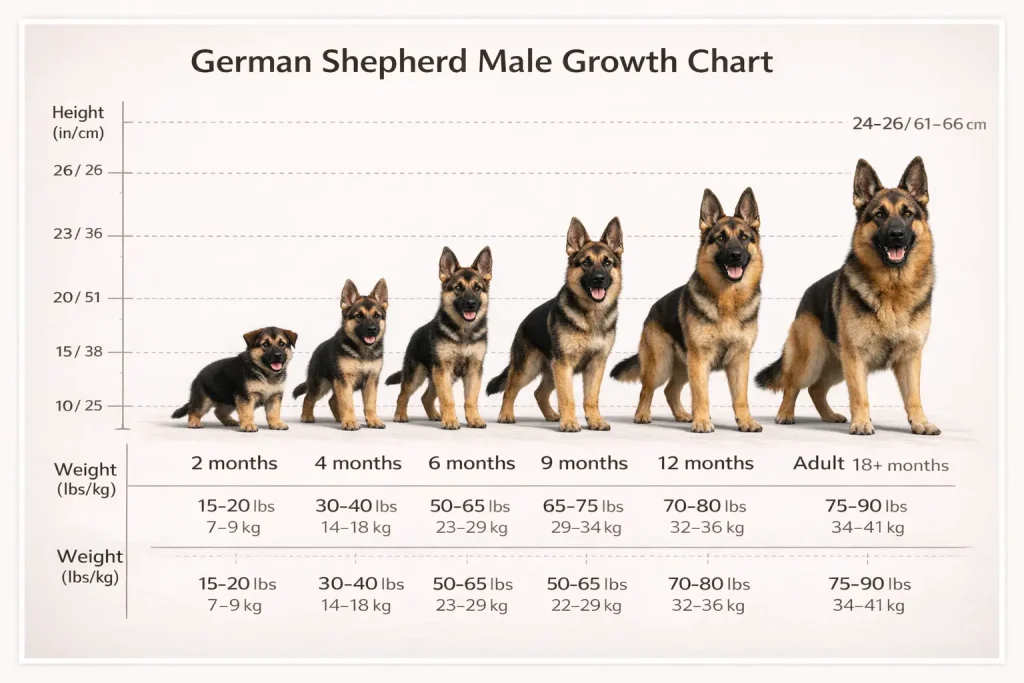
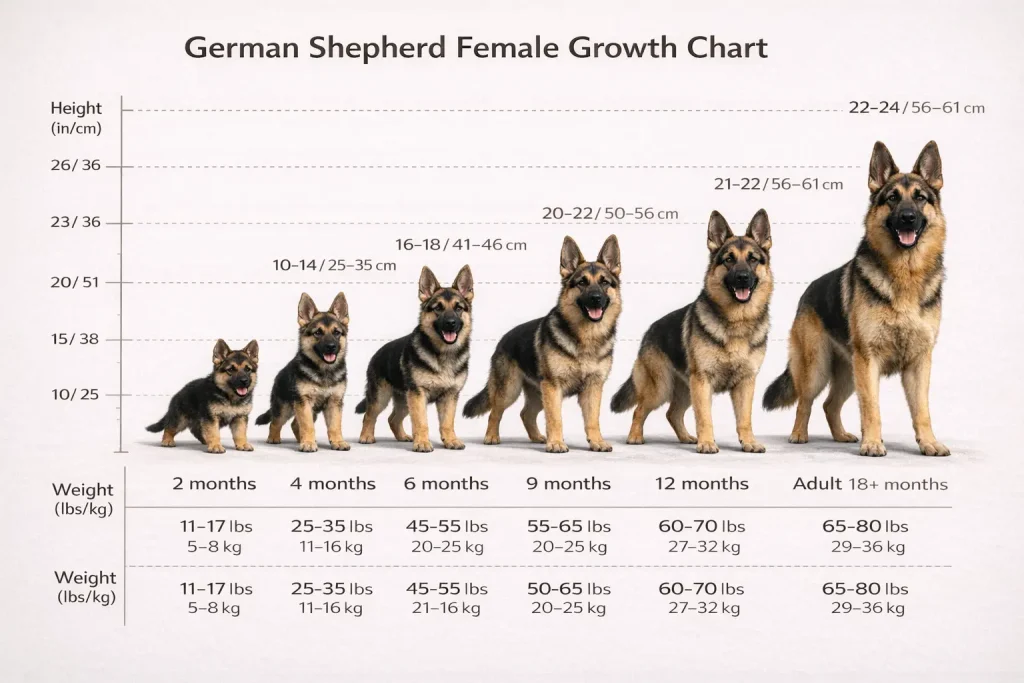
This chart shows average weight ranges for German Shepherd puppies at each stage of development. Use this as a general guideline, not an exact predictor.

Growth Chart: Male German Shepherds

AgeWeight RangeHeight at Shoulder
1 month5.5-9 lbs4-6 inches
2 months16-20 lbs7-9 inches
3 months26-32 lbs9-11 inches
4 months35-45 lbs11-14 inches
5 months45-55 lbs14-16 inches
6 months53-64 lbs16-19 inches
7 months57-68 lbs19-20 inches
8 months60-71 lbs20-22 inches
9 months63-75 lbs21-23 inches
10 months66-78 lbs22-24 inches
11 months67-80 lbs22-24 inches
12 months68-82 lbs22-24 inches
18 months70-85 lbs23-25 inches
2-3 years65-90 lbs24-26 inches (fully grown)

Growth Chart: Female German Shepherds

AgeWeight RangeHeight at Shoulder
1 month4.5-8 lbs3-6 inches
2 months11-17 lbs6-9 inches
3 months22-30 lbs8-10 inches
4 months31-40 lbs10-12 inches
5 months38-49 lbs12-14 inches
6 months44-55 lbs15-17 inches
7 months48-59 lbs17-19 inches
8 months51-63 lbs18-20 inches
9 months53-66 lbs19-21 inches
10 months55-68 lbs19-21 inches
11 months57-70 lbs20-22 inches
12 months58-70 lbs20-22 inches
18 months60-70 lbs21-23 inches
2-3 years50-70 lbs22-24 inches (fully grown)

Remember: These are averages. Your GSD may grow faster or slower and still be perfectly healthy. What matters more than exact numbers is consistent, steady growth and overall body condition.

German-Shepherd-female size-chart-showing-development-from-puppy-to-full-grown

When Do German Shepherds Stop Growing?

This is one of the most common questions GSD owners ask, and the answer isn’t as simple as a single age.

Height Growth (Reaches Full Height First)

Males: Typically reach full height by 12-18 months
Females: Typically reach full height by 12-16 months

Once your GSD reaches their adult height, they won’t get any taller. The growth plates in their long bones close, ending vertical growth.

Weight and Muscle Development (Continues Longer)

Males: Continue filling out and adding muscle until 2-3 years old
Females: Continue filling out until 2-2.5 years old

Even after reaching full height, German Shepherds continue to gain weight as they develop muscle mass and their chest deepens. A 15-month-old male might be his full height but still look lanky compared to his appearance at 2.5 years when he’s fully filled out.

Full Physical Maturity

Complete maturity: 2-3 years old for both sexes

This is when your German Shepherd is considered fully grown—not just in height, but in muscle development, bone density, and overall physical structure.

Hazel’s Experience:
Luna reached her full height of 24 inches by about 14 months, but she continued filling out and gaining muscle until she was nearly 2.5 years old. At 18 months, she looked like a tall, skinny teenager. By 2.5 years, she’d developed into a strong, well-proportioned adult.


Factors That Affect German Shepherd Size

Not all German Shepherds end up the same size, even with the same parents. Multiple factors influence adult size.

1. Genetics (Primary Factor)

Parental size is the biggest predictor of puppy size. If both parents are on the larger end of the breed standard, their puppies likely will be too.

Bloodline matters:

  • Working line GSDs tend to be slightly smaller and more compact
  • Show line GSDs tend to be larger with more bone structure
  • American vs. European lines show size variations

How to predict adult size:
Look at the parents. Your puppy will likely fall somewhere between the mother’s and father’s size, though males typically match or exceed the father’s size, and females typically match or exceed the mother’s size.

2. Nutrition During Growth

Proper nutrition supports optimal growth:

  • Large breed puppy food controls growth rate (prevents too-fast growth)
  • Adequate protein supports muscle development
  • Balanced calcium/phosphorus ratios support healthy bones

Over-nutrition problems:
Feeding too much or using high-calorie food causes puppies to grow too fast, increasing hip dysplasia risk and joint problems.

Under-nutrition problems:
Insufficient food prevents puppies from reaching genetic size potential and can cause developmental issues.

The goal: Steady, controlled growth not maximum size or fastest growth.

3. Sex (Males vs. Females)

Males are consistently larger than females in both height and weight. This size difference is evident even in puppyhood and becomes more pronounced as dogs mature.

Typical difference: Males are 10-20 pounds heavier and 2-3 inches taller than females at maturity.

4. Spay/Neuter Timing

Early spay/neuter (before 6 months) can result in:

  • Slightly taller adult height (growth plates stay open longer)
  • Lankier build with less muscle mass
  • Increased risk of joint problems

Later spay/neuter (after 12-18 months) allows:

  • Growth plates to close naturally
  • Normal muscle development
  • Body proportions that match breed standard

Most veterinarians now recommend waiting until at least 12 months for large breed dogs like German Shepherds, though individual circumstances vary.

5. Health and Medical Issues

Conditions that can stunt growth:

  • Parasites (worms rob nutrients needed for growth)
  • Chronic illness during puppyhood
  • Severe nutritional deficiencies
  • Hormonal imbalances

Early treatment of health issues ensures puppies can reach their genetic potential.

6. Exercise During Growth Period

Moderate exercise supports healthy growth:

  • Controlled leash walks
  • Free play on soft surfaces
  • Swimming

Excessive exercise harms growing joints:

  • Forced running or jogging before 18 months
  • Repetitive jumping (on/off furniture, agility)
  • Long-distance hiking before maturity

The balance: Enough activity to build healthy muscles without damaging developing joints and bones.


How to Tell If Your German Shepherd Is the Right Size

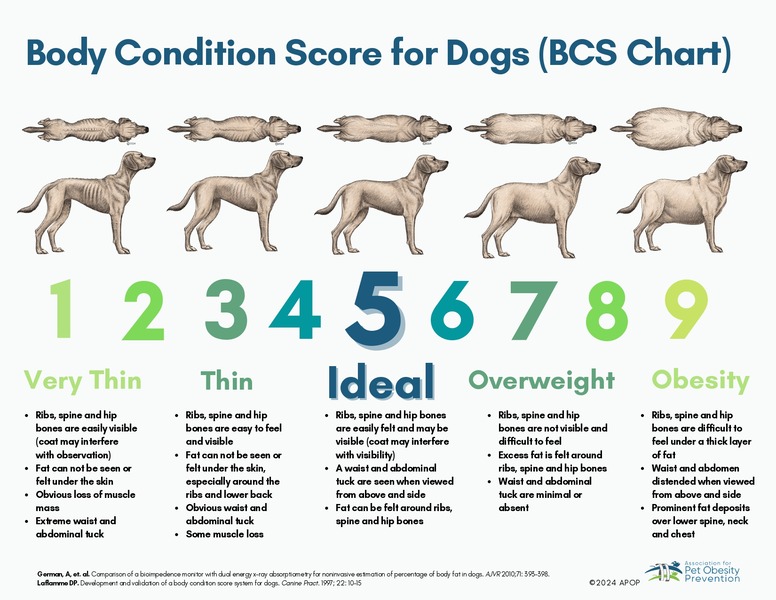
German-Shepherd-body-condition-chart-showing-underweight-ideal-weight-and-overweight-comparison

Numbers on a scale don’t tell the whole story. Body condition matters more than weight alone.

Ideal Body Condition for German Shepherds

When viewed from above:

  • Clear waist behind the ribs
  • Hourglass shape (not straight from shoulders to hips)

When viewed from the side:

  • Abdominal tuck (belly slopes up from chest to hips)
  • Not sagging or hanging

When you touch their sides:

  • Ribs easily felt but not visibly protruding
  • Slight fat covering over ribs
  • Spine felt but not prominent

Signs Your GSD Is Underweight

  • Ribs, spine, and hip bones clearly visible
  • No fat covering over bones
  • Severe waist and abdominal tuck
  • Loss of muscle mass
  • Low energy levels

Action: Increase food portions gradually and consult your vet to rule out health issues.

Signs Your GSD Is Overweight

  • Ribs difficult to feel under fat layer
  • No visible waist when viewed from above
  • No abdominal tuck; belly hangs down
  • Fat deposits at tail base and shoulders
  • Difficulty breathing or moving

Action: Reduce food portions by 10-20%, increase exercise, and consult your vet for a weight loss plan. Obesity severely impacts joint health and overall wellbeing in German Shepherds.

Monthly Weight Checks

Weigh your GSD monthly to track growth patterns and catch problems early. For puppies, weekly weigh-ins help ensure steady growth. For adults, monthly checks help maintain ideal weight.

Hazel’s Method:
I weigh myself, then weigh myself holding Luna, and calculate the difference. It’s not perfect, but it’s close enough for tracking trends. For puppies, a luggage scale works great.


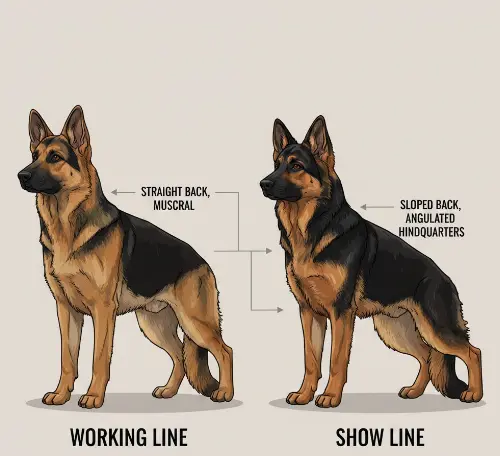
Working Line vs. Show Line Size Differences

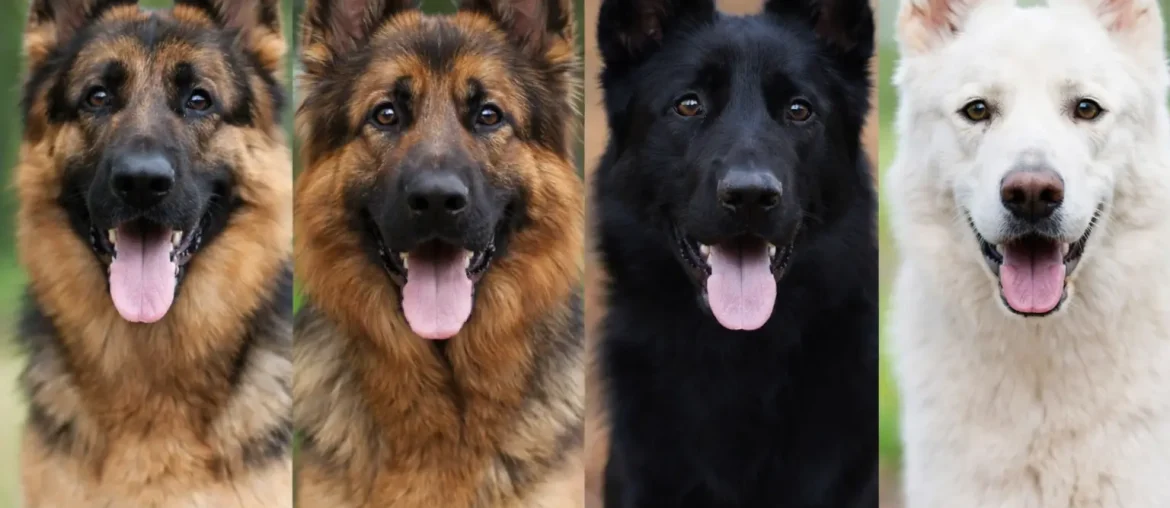
Working line versus show line German Shepherd size and build comparison

German Shepherds bred for different purposes show size variations.

Working Line German Shepherds

Characteristics:

  • Slightly smaller and more compact
  • Males: 60-75 pounds, Females: 45-60 pounds
  • More athletic, less angulation
  • Bred for function over appearance

Why they’re smaller:
Working dogs need endurance, agility, and efficiency. Extra size adds weight without improving working ability, so working lines have been selectively bred for optimal performance size.

Show Line German Shepherds

Characteristics:

  • Larger, heavier bone structure
  • Males: 75-90 pounds, Females: 55-70 pounds
  • More angulation, sloped topline
  • Bred to meet conformation standards

Why they’re larger:
Show standards favor substantial bone, size, and presence. Show line breeders select for dogs that command attention in the ring.

Which is healthier?
Neither is inherently healthier based on size alone, though working lines’ straighter backs may reduce some joint stress. Health depends more on breeding practices, genetic testing, and individual care than size category.


Size Comparison: German Shepherds vs. Other Breeds

Understanding GSD size in context helps prospective owners know what to expect.

Larger than German Shepherds:

  • Rottweiler: 80-135 pounds
  • Great Dane: 110-175 pounds
  • Mastiff: 120-230 pounds

Similar size to German Shepherds:

  • Labrador Retriever: 55-80 pounds
  • Golden Retriever: 55-75 pounds
  • Belgian Malinois: 40-80 pounds

Smaller than German Shepherds:

  • Border Collie: 30-55 pounds
  • Australian Shepherd: 40-65 pounds
  • Beagle: 20-30 pounds

Why this matters:
German Shepherds are large dogs requiring space, appropriate vehicles, larger gear, and the physical ability to handle a strong, active 65-90 pound animal.


How to Predict Your Puppy’s Adult Size

While you can’t know exactly, these methods give reasonable estimates.

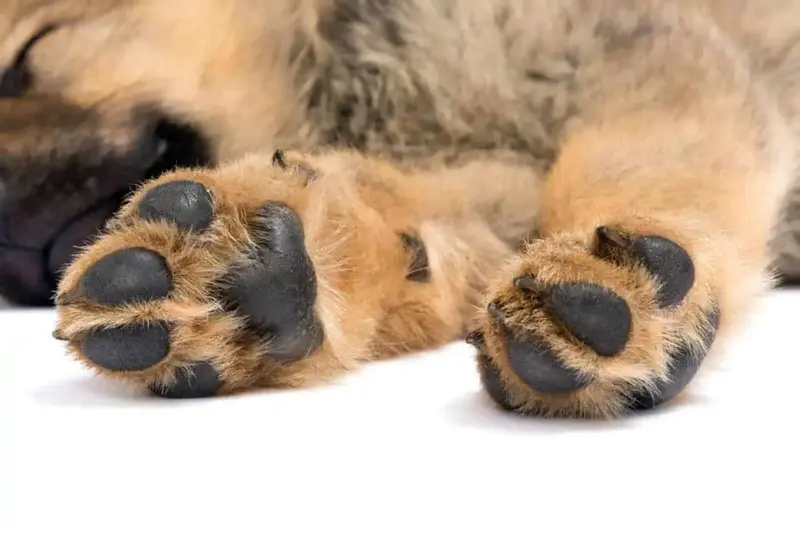
Method 1: Paw Size

Large paws relative to body often indicate a larger adult dog. Puppies grow into their paws, so oversized puppy paws suggest significant growth ahead.

Limitation: Not scientifically precise, but a useful general indicator.

Method 2: Parental Size

Most reliable method:

  • Males usually match or slightly exceed father’s size
  • Females usually match or slightly exceed mother’s size

Ask the breeder for parent weights and heights if you purchased from a breeder.

Method 3: Weight at 3-4 Months

Rough estimate:
A puppy’s weight at 3-4 months is approximately half their adult weight.

Example:

  • 30-pound male puppy at 3 months → approximately 60-70 pound adult
  • 35-pound male puppy at 4 months → approximately 70-80 pound adult

Limitation: Individual variation means this is only a rough estimate.

Method 4: Growth Rate Observation

Fast-growing puppies (those consistently at the upper end of weight ranges) typically become larger adults.

Slower-growing puppies (those at the lower end of ranges) typically become smaller adults.

Track weekly or monthly weight and compare to the growth chart to see your puppy’s trend.


Common Size-Related Concerns

“My Puppy Seems Too Small”

When to worry:

  • Puppy is significantly below the low end of weight range
  • Not gaining weight consistently
  • Appears lethargic or unhealthy
  • Severe body condition (very thin, visible bones)

When not to worry:

  • Puppy is active, energetic, and healthy
  • Growing steadily even if on the smaller end
  • Parents are smaller GSDs (genetics)

Action: If growth has stopped or puppy seems unwell, consult your vet.


“My Puppy Seems Too Big”

When to worry:

  • Growing extremely fast (much faster than chart)
  • Visibly overweight with no waist
  • Limping or showing joint pain
  • Being overfed high-calorie food

When not to worry:

  • Large but proportional and healthy
  • Parents are large GSDs
  • Steady growth without sudden spikes
  • Lean body condition despite size

Action: If puppy is overweight, reduce food by 10-20% and switch to large breed puppy formula.


“My GSD Stopped Growing Early”

Possible reasons:

  • Reached genetic potential (some dogs mature earlier)
  • Early spay/neuter affected growth
  • Nutritional deficiency during growth
  • Health issue impacting development

Action: If your GSD is healthy, active, and proportional, early maturity is fine. If concerned, consult your vet.


“My GSD Is Still Growing After 2 Years”

Normal in males:
Males can continue filling out and adding muscle until 2.5-3 years old. Height growth stops earlier, but weight can still increase.

Less common in females:
Females typically finish by 2-2.5 years, but late bloomers exist.

When to check with vet:
If your GSD continues gaining significant weight after 2.5 years, ensure it’s muscle (healthy) and not fat (concerning).


Maintaining Healthy Weight Throughout Life

Size at maturity is just the beginning. Maintaining ideal weight throughout your GSD’s life protects their health.

Puppy Stage (0-12 Months)

Goal: Controlled, steady growth

Feeding guidelines:

  • Large breed puppy food only
  • Follow package guidelines but adjust for body condition
  • Avoid over-supplementing calcium
  • Feed 3-4 meals daily until 6 months, then 2 meals

Monitor: Weekly weigh-ins, monthly body condition checks


Adult Stage (1-7 Years)

Goal: Maintain ideal weight and muscle mass

Feeding guidelines:

Monitor: Monthly weigh-ins, watch for weight creep


Senior Stage (7+ Years)

Goal: Prevent obesity while maintaining muscle

Feeding guidelines:

  • Senior formula or lower-calorie adult food if activity decreases
  • May need fewer calories as metabolism slows
  • Continue joint support supplements
  • Maintain protein for muscle preservation

Monitor: Monthly weigh-ins, adjust quickly if weight increases

Hazel’s Approach:
Luna gets fed twice daily with portions adjusted based on her activity level. More hiking in summer means slightly more food. Less activity in winter means slightly less. I weigh her monthly and adjust immediately if I notice changes.


Size and Health Connections

German Shepherd size directly impacts certain health considerations.

Joint Health

Larger GSDs have more stress on joints, increasing arthritis and hip dysplasia risk. Maintaining lean body weight throughout life is crucial.

Every extra pound adds approximately four pounds of pressure on joints.

Lifespan Correlation

Smaller German Shepherds (within breed standard) tend to live slightly longer than very large ones. Size extremes at either end can indicate breeding issues.

Optimal size for longevity appears to be middle-of-the-range for the breed standard.

Heart Health

Very large GSDs have higher risk of dilated cardiomyopathy (DCM) and other heart issues. Proper nutrition and avoiding obesity protect heart health.


healthy-GSD

Final Thoughts

German Shepherd size is wonderfully varied within the breed standard, and every size brings something special. Luna, at 72 pounds, is perfect for my lifestyle—big enough to feel substantial but small enough to manage easily.

Whether your German Shepherd ends up 55 pounds or 90 pounds, what matters most is that they’re healthy, well-proportioned, and thriving. Focus less on reaching a specific number and more on maintaining ideal body condition, providing proper nutrition, and supporting healthy growth.

Your GSD’s size is largely determined by genetics, but you control the factors that ensure they reach their healthy potential: quality food, appropriate exercise, proper veterinary care, and lots of love.

Watch those growth charts as guidelines, not rigid rules. Celebrate your German Shepherd’s unique size, and remember that the best size for your GSD is the healthy, happy size they’re meant to be.

💡 Want to support healthy growth and development?
Learn about proper nutrition for German Shepherds and how diet impacts size, joint health, and overall wellbeing.


More German Shepherd Breed Guides

  • Male vs. Female German Shepherds: Which Should You Choose? — Temperament and size differences
  • German Shepherd Colors: Complete Guide to Coat Colors — All color variations explained
  • Are German Shepherds Good Family Dogs? — Temperament and suitability

Explore all GSD breed facts →


Trusted Resources


Keywords: German Shepherd size, GSD weight chart, German Shepherd growth chart, how big do German Shepherds get, German Shepherd height, when do German Shepherds stop growing


How big is your German Shepherd? Did they end up larger or smaller than you expected? Share your GSD’s size in the comments!

By Hazel Sloane

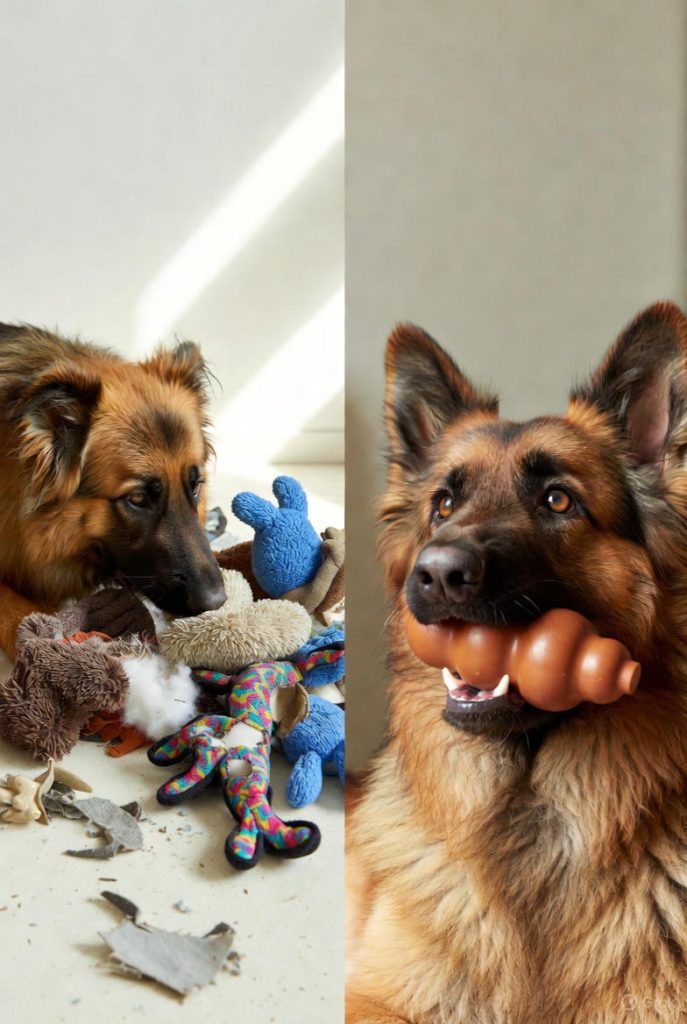
Discover the only toys that survive German Shepherds’ powerful jaws—from indestructible chew toys to mind-challenging puzzles that actually keep your GSD engaged.


I’ve spent more money on destroyed dog toys than I care to admit. In Luna’s first year alone, I must have thrown away two dozen toys—shredded plush animals, demolished rubber balls, and rope toys that became dangerous strings within hours.

The breaking point came when Luna swallowed a chunk of a “heavy-duty” toy that required an emergency vet visit and $800 surgery to remove. That’s when I learned the hard way: German Shepherds don’t need just any toys. They need toys specifically designed to withstand their intelligence, jaw power, and relentless determination.

After years of trial and error (and a lot of wasted money), I’ve finally figured out which toys actually survive my GSDs and more importantly, which ones keep them mentally stimulated, physically exercised, and safely entertained.

Here’s everything you need to know about choosing toys that won’t end up in the trash within a week.


Why German Shepherds Need Special Toys

German Shepherds aren’t your average dogs, and they destroy toys for very specific reasons.

They’re Incredibly Intelligent

With intelligence comparable to a 2-3 year old child, German Shepherds get bored easily. A simple squeaky toy might entertain a less intelligent breed for hours, but your GSD will figure it out in five minutes and move on to destroying it.

What this means for toys: You need toys that challenge their minds—puzzles, interactive games, and toys that require problem-solving.

They Have Crushing Jaw Strength

German Shepherds have a bite force of approximately 238 PSI (pounds per square inch). That’s enough to crush most “durable” toys marketed to regular dogs.

What this means for toys: Only industrial-strength materials survive. If a toy is marketed for “all dogs,” it probably won’t last a week with a GSD.

Working Breed Instincts Run Deep

Even family-pet German Shepherds retain strong working instincts. They need jobs, tasks, and activities that engage their natural drive to work and problem-solve.

What this means for toys: Fetch toys, tug toys, and interactive puzzles satisfy their need to work and accomplish tasks.

High Energy Levels Demand Outlets

An under-stimulated German Shepherd will find their own entertainment—and you won’t like their choices. Chewed furniture, destroyed shoes, and dug-up yards are all symptoms of a bored GSD.

What this means for toys: You need a variety of toys that provide both physical exercise and mental exhaustion.

The Real Cost of Cheap Toys

Here’s what I wish someone had told me from the start: cheap toys don’t save money. They cost more in the long run because:

  • You’re constantly replacing them
  • Destroyed toys create choking and blockage hazards
  • Emergency vet visits cost thousands
  • Your dog learns that destroying toys is the goal

Hazel’s Reality Check:
One $30 Kong has lasted Luna three years. Twenty $5 toys lasted a combined two weeks. Do the math.


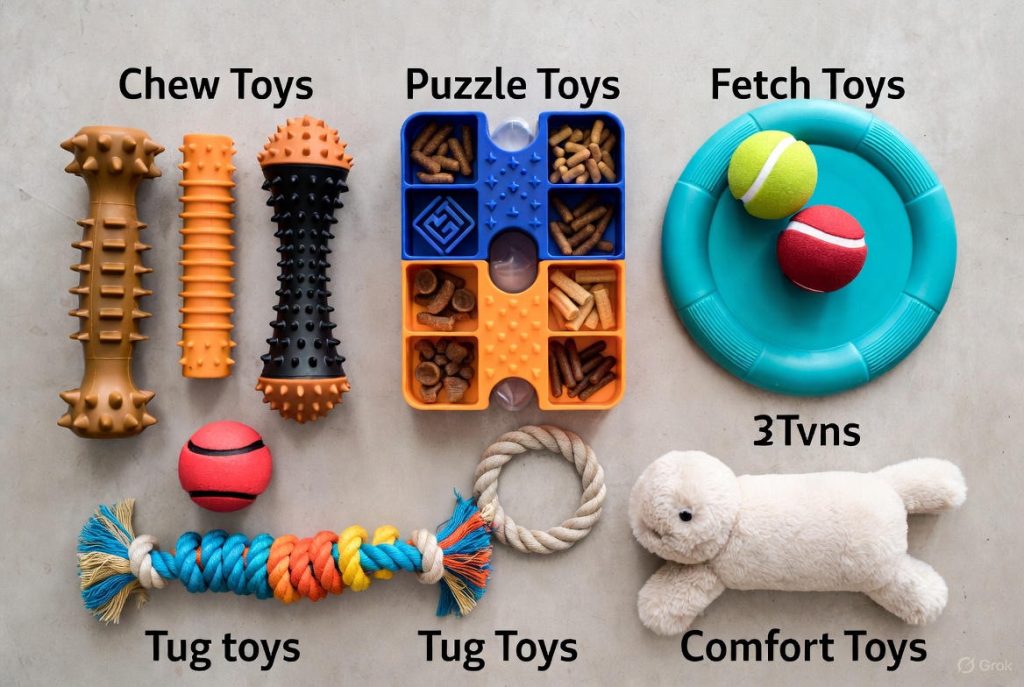
Types of Toys Every German Shepherd Needs

A well-rounded toy collection addresses different needs throughout your GSD’s day.

Chew Toys

Purpose: Satisfy natural chewing instinct, occupy alone time, support dental health

Best for: Crate training, when you can’t supervise, calming anxiety

Interactive Puzzle Toys

Purpose: Mental stimulation, slow feeding, problem-solving engagement

Best for: Preventing boredom, rainy days, mental exhaustion

Fetch Toys

Purpose: Physical exercise, bonding time, burning energy

Best for: Outdoor play, training recall, building relationship

Tug Toys

Purpose: Strength building, interactive play, teaching impulse control

Best for: Bonding time, training “drop it,” high-energy play sessions

Comfort Toys

Purpose: Anxiety relief, companionship, calming presence

Best for: Crate time, separation anxiety, nighttime settling

Why variety matters:
Just like you’d get bored eating the same meal every day, your GSD needs different types of engagement. Rotate toys to keep interest high and address different needs throughout the day.


Best Indestructible Chew Toys for German Shepherds

These are the only chew toys that have survived my power-chewer GSDs long-term.

Quick Comparison: Top Indestructible Chew Toys

ToyDurabilityBest ForPrice RangeDishwasher Safe
Kong ExtremeExcellentStuffing, freezing$15-25Yes
Benebone WishboneVery GoodLong chew sessions$10-20No
West Paw HurleyExcellentWater play, fetch$15-30Yes
Goughnuts MaXXOutstandingExtreme chewers$30-40Yes
Elk AntlersExcellentNatural chewers$15-35N/A
Best indestructible chew toys for German Shepherds comparison

1. Kong Extreme (Black)

Why it’s indestructible:
Made from ultra-durable black rubber specifically formulated for power chewers, the Kong Extreme is virtually impossible to destroy. I’ve had the same Kong for three years with Luna, and it still looks nearly new.

How to use it:

  • Stuff with peanut butter, kibble, or treats
  • Freeze for longer-lasting engagement (Luna’s frozen Kongs keep her busy for 45+ minutes)
  • Use during crate training or alone time
  • Varies in size – choose large or XL for adult GSDs

Best for: Heavy chewers, anxiety management, crate training, keeping dogs occupied when you can’t supervise

Hazel’s Tip:
My go-to Kong recipe: Layer kibble, peanut butter, mashed banana, more kibble, then seal the small opening with a bit of cheese. Freeze overnight. This keeps Luna entertained for nearly an hour.

Price: $15-25 depending on size

German Shepherd chewing Kong Extreme black rubber toy

2. Benebone Wishbone

Why it’s durable:
Made from super-strong nylon infused with real flavors (bacon, chicken, peanut butter), Benebones are designed specifically for aggressive chewers. The wishbone shape makes it easy for dogs to grip.

How to use it:

  • Let your dog chew in supervised sessions
  • Replace when significantly worn down
  • Choose flavor based on your dog’s preferences
  • Ergonomic design — they can hold it with paws while chewing

Best for: Dogs who need long-lasting chew satisfaction, aggressive chewers who go through regular toys in minutes

Important note: These are meant for chewing, not eating. Supervise initially to ensure your dog isn’t trying to swallow large pieces.

Price: $10-20


3. West Paw Zogoflex Hurley

Why it works:
USA-made from Zogoflex material that’s FDA-compliant, non-toxic, and backed by West Paw’s guarantee. If your dog destroys it, they’ll replace it. The material is also buoyant, making it perfect for water play.

How to use it:

  • Fetch on land or in water
  • Toss it for your GSD to chase and retrieve
  • Dishwasher safe for easy cleaning
  • Floats for lake or pool play

Best for: Active GSDs who love fetch, dogs who play rough, water-loving dogs

Bonus: Comes in bright colors for high visibility

Price: $15-30 depending on size


4. Goughnuts MaXX Ring

Why it’s the toughest:
Goughnuts are made from industrial-strength rubber with a unique safety feature is a red inner core. If you ever see red showing through, it’s time to replace the toy (and Goughnuts will replace it for free). The MaXX line is specifically for the most powerful chewers.

How to use it:

  • Tug play
  • Solo chewing
  • Fetch (it has good bounce)
  • Check regularly for red indicator

Best for: The absolute most aggressive chewers, dogs who’ve destroyed every other “indestructible” toy

Important: These are not cheap, but they last years. If you’ve wasted money on destroyed toys, this is worth the investment.

Price: $30-40


5. Elk or Deer Antlers (Natural Chews)

Why they last:
Natural antlers are incredibly dense and long-lasting. A single elk antler can provide weeks or even months of chewing satisfaction for most GSDs.

How to choose and use:

  • Choose split antlers (easier to chew, less tooth fracture risk)
  • Size matters—choose larger antlers for adult GSDs
  • Supervise initially to ensure appropriate chewing
  • Remove when worn down to a small nub

Best for: Natural chewing satisfaction, dogs who like the texture and taste of natural products, long-lasting chewing

Safety considerations:

  • Never give cooked bones (they splinter)
  • Watch for aggressive chewers who might crack teeth on whole antlers
  • Some dogs aren’t interested — it’s a personal preference thing

Hazel’s Experience:
Luna loves split elk antlers. One large antler lasts her about 2-3 months. Not all dogs love them, though—my previous GSD wasn’t interested at all.

Price: $15-35 depending on size


What to AVOID: Dangerous Chew Toys

Rawhide

  • Can cause choking or intestinal blockages
  • Often treated with harmful chemicals
  • Swells in the stomach

Cooked Bones

  • Splinter and cause internal damage
  • Can puncture intestines
  • Tooth fracture risk

Cheap Plush Toys

  • Stuffing causes blockages if swallowed
  • Squeakers are choking hazards
  • Fall apart within minutes with power chewers

Tennis Balls (for heavy use)

  • Abrasive surface wears down tooth enamel
  • Can be torn apart and swallowed
  • Fine for occasional fetch but not daily chewing

Best Interactive Puzzle Toys for Mental Stimulation

German Shepherd solving interactive puzzle toy for mental stimulation

Here’s a secret many GSD owners don’t realize: 15 minutes of mental work exhausts your dog as much as 30 minutes of physical exercise.

Puzzle toys aren’t just entertainment—they’re essential for preventing destructive behavior caused by boredom and under-stimulation.

1. Outward Hound Hide-A-Squirrel (Beginner Level)

How it works:
A plush tree trunk with holes and several squeaky squirrels. Dogs pull the squirrels out of the trunk, and you can hide them again for repeated play.

Why GSDs love it:
It engages their prey drive and problem-solving skills without being too frustrating for beginners.

Difficulty levels:
Comes in different sizes (small trunk with 3 squirrels up to jumbo with 6+ squirrels)

Best for: Dogs new to puzzle toys, building confidence, teaching problem-solving

Durability note: The plush won’t survive aggressive chewing, but for puzzle play (not chewing), it holds up well. I’ve had ours for over a year.

Price: $15-30


2. Nina Ottosson Dog Brick (Intermediate Level)

How it works:
Sliding compartments and flip lids hide treats. Dogs must slide blocks and flip covers to reveal rewards.

Why it’s perfect for GSDs:
Multiple difficulty levels in one toy. Start easy with treats visible, then increase challenge by hiding treats under multiple layers.

Features:

  • Dishwasher safe
  • Durable plastic construction
  • BPA-free materials

Best for: Smart dogs ready for a challenge, mealtime enrichment (use kibble), keeping dogs engaged for 15-20 minutes

Hazel’s Strategy:
I use the Dog Brick with Luna’s breakfast kibble 2-3 times per week. It slows down eating and makes mealtime mentally engaging.

Price: $20-35


3. KONG Wobbler

How it works:
A weighted, egg-shaped toy that wobbles and dispenses treats or kibble as your dog pushes it around.

Why GSDs love it:
Combines physical activity with problem-solving. They have to figure out how to make it dispense food.

Benefits:

  • Slows down fast eaters
  • Good physical + mental combo
  • Adjustable difficulty (control dispensing hole size)
  • Durable hard plastic

Best for: Mealtime enrichment, slowing down eating, dogs who need both mental and physical stimulation

Price: $15-20


4. Trixie Mad Scientist Turn Around (Advanced Level)

How it works:
Multi-step puzzle with “beakers” that must be turned, lifted, or flipped in sequence to reveal treats.

Why it’s challenging:
Requires multiple problem-solving steps. Most dogs need several sessions to master it.

Best for: Extremely intelligent GSDs who’ve mastered easier puzzles, dogs who get bored easily, rainy day mental exhaustion

Important: This is genuinely difficult. Some dogs get frustrated—watch body language and help if needed.

Price: $25-40


5. Snuffle Mats

How they work:
Fabric strips create a “grass-like” surface where you hide kibble or treats. Dogs use their nose to forage and find food.

Why GSDs love them:
Engages their incredible sense of smell and mimics natural foraging behavior. Very calming activity.

Benefits:

  • Slows eating
  • Mentally engaging but not frustrating
  • Machine washable
  • Great for all ages, including seniors

Best for: Scent work, calming anxious dogs, mealtime enrichment, dogs recovering from injury (mental stimulation without physical activity)

Hazel’s Routine:
I rotate 3-4 puzzle toys throughout the week so Luna doesn’t get bored. Monday might be the Wobbler, Wednesday the Dog Brick, Friday a snuffle mat. Variety keeps it interesting.

Price: $20-35


Best Fetch Toys for Exercise and Bonding

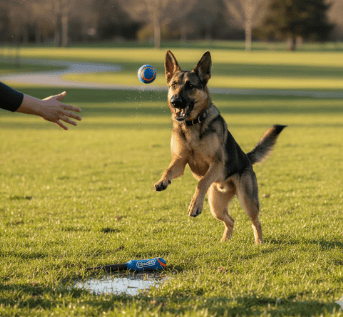
German-Shepherd playing-fetch-with durable-ChuckIt-Ultra-Ball

Fetch isn’t just exercise—it’s bonding time, training opportunity, and a way to burn off energy fast.

What Makes a Good Fetch Toy for GSDs

  • Highly visible (bright colors)
  • Easy to pick up (ergonomic shape)
  • Durable (survives repeated throws and chomps)
  • Safe for teeth (no hard plastic that cracks teeth)

1. ChuckIt! Ultra Ball

Why it’s better than tennis balls:

  • Bounces higher and farther
  • More durable rubber
  • Bright orange and blue colors
  • Compatible with ChuckIt! ball launchers
  • Doesn’t wear down teeth like tennis balls

Best for: High-energy fetch sessions, long-distance throwing, dogs who love to chase

Sizes: Multiple sizes available—choose large for GSDs

Hazel’s Tip:
The ball launcher lets me throw 3X farther with less effort. Luna gets way more exercise, and my shoulder doesn’t hurt.

Price: $8-15 (balls), $15-30 (launcher)


2. West Paw Zogoflex Zisc (Flying Disc)

Why it’s indestructible:
Made from the same Zogoflex material as the Hurley—tough enough to survive power chewers but soft enough not to hurt their mouths.

Features:

  • Floats for water play
  • Guaranteed tough (West Paw replaces if destroyed)
  • Bright colors for visibility
  • Dishwasher safe

Best for: GSDs who love frisbee, beach or lake play, dogs learning disc sports

Important: Proper frisbee throwing takes practice. Start low and slow to build your dog’s confidence and catching skills.

Price: $15-20


3. Goughnuts Fetch Stick

Why it’s safer than real sticks:
Real sticks splinter, puncture mouths, and cause serious injuries. This indestructible stick alternative gives dogs the satisfaction of carrying a stick without the danger.

Features:

  • Floats (great for water fetch)
  • Same safety indicator as Goughnuts rings
  • Multiple sizes

Best for: Dogs who love carrying and fetching sticks, water fetch, safety-conscious owners

Price: $20-30


4. KONG Flyer

Why it’s gentler:
Softer, more flexible material than the Zisc. Good for dogs learning to catch frisbees or those with sensitive mouths.

Best for: Beginners, older dogs, dogs with dental issues

Durability note: Not as indestructible as the Zisc, but still far more durable than cheap plastic discs.

Price: $10-15


What to Avoid in Fetch Toys

Regular tennis balls for daily use — Abrasive surface wears down tooth enamel over time; fine for occasional play but not daily chewing

Small balls — Choking hazard; always choose large balls for GSDs

Cheap plastic frisbees — Shatter and create sharp edges that cut mouths


Best Tug Toys for Strength and Bonding

German-Shepherd playing-tug-of war-with-owner using-rope-toy

Tug-of-war gets a bad reputation, but when played with rules, it’s one of the best activities for German Shepherds.

Why Tug Is Great for GSDs

Builds strength — Jaw, neck, and core muscles get a workout

Burns energy fast — 10 minutes of vigorous tug = 30 minutes of walking

Teaches impulse control — “Take it” and “drop it” commands during play

Strengthens bond — Interactive play builds trust and connection

Satisfies natural instincts — GSDs were bred to grip and hold


1. Mammoth Flossy Chews Rope

Why it’s classic:
100% cotton rope that’s virtually indestructible for tug play. The rope action also provides dental benefits by flossing between teeth.

Features:

  • Multiple sizes (choose XL for GSDs)
  • Machine washable
  • Natural cotton (safe if small fibers are swallowed)

Best for: Classic tug-of-war, dogs who love rope texture, dental health

Safety note: Always supervise rope play. If the toy starts unraveling significantly, replace it—long strings can cause intestinal blockages.

Price: $10-25 depending on size


2. KONG Tug Toy

Why it’s better for humans:
Rubber grips on both ends make it comfortable for human hands during vigorous tugging. The middle section is durable rubber your dog can grip.

Features:

  • Extremely durable
  • Easy to clean
  • Comfortable grip
  • Multiple sizes

Best for: Dogs who tug hard, owners who want comfortable grip, all-weather play

Price: $15-25


3. West Paw Bumi

Why it’s unique:
Stretchy, flexible design that gives with your dog’s pulling motion. Gentler on joints than rigid tug toys.

Features:

  • Floats (great for water tug)
  • Zogoflex material (dishwasher safe)
  • Stretches up to twice its length
  • Bright colors

Best for: Senior dogs, dogs with joint issues, gentle tug play, water play

Price: $15-20


Tug Rules for Safe Play

1. You control when the game starts and stops — Don’t let your dog initiate by shoving the toy at you

2. Teach “drop it” before playing tug — The game stops immediately if they don’t drop on command

3. Never let the dog “win” by ripping the toy away — You decide when to release

4. No teeth on skin, ever — Even accidental contact means game over

5. Keep arousal moderate — If your dog gets too worked up (growling, overly intense), take breaks

When to avoid tug: If your dog shows any possessive aggression over toys, work with a trainer before playing tug.


Comfort & Anxiety Toys for Calming

Not all toys are for active play — some provide comfort and security.

1. Snuggle Puppy (Heartbeat Toy)

How it works:
Battery-powered device simulates a heartbeat. Some versions include microwaveable heat packs that mimic a mother’s warmth.

Why it helps:
The rhythmic heartbeat is calming, especially for puppies or anxious dogs. Mimics the comfort of being with another dog.

Best for:

  • New puppies adjusting to their new home
  • Dogs with separation anxiety
  • Crate training
  • Nighttime settling
  • During thunderstorms or fireworks

Price: $30-40


2. KONG Cozies (Plush Comfort Toys)

What they are:
Soft, minimal-stuffing plush toys designed for gentle play and comfort.

Important note: These are NOT for aggressive chewers. They’re for dogs who enjoy carrying plush toys without destroying them.

Best for: Dogs who like soft toys, gentle play, companionship, carrying around the house

Comes in fun designs: Various animals, cute characters

Price: $8-15


3. Heartbeat Pillow

Similar to Snuggle Puppy but larger:
A pillow-sized version with heartbeat simulator.

Best for: Larger dogs, crate use, dogs who like to rest their head on something

Price: $25-35


When to Use Comfort Toys

  • During crate time (provides companionship)
  • Thunderstorms or fireworks (calming presence)
  • When home alone (reduces anxiety)
  • Nighttime settling (helps puppies sleep)
  • After stressful events (vet visits, grooming)

Hazel’s Perspective:
Luna isn’t big on plush toys, but my friend’s GSD carries his Snuggle Puppy everywhere. Every dog is different—some need comfort toys, others don’t care.


DIY & Budget-Friendly Toy Options

DIY budget-friendly-dog-toys-for-German-Shepherds-including-muffin-tin-puzzle

Quality toys are worth the investment, but not everything needs to be expensive. Here are budget-friendly options that actually work.

1. Frozen Towel Toy

How to make it:

  • Soak a rope or towel in water
  • Tie it in knots
  • Freeze solid

Why it works:
Great for teething puppies or hot summer days. The cold soothes gums, and the texture is satisfying to chew.

Cost: Free


2. Muffin Tin Puzzle

How to make it:

  • Place treats in muffin cups
  • Cover each cup with a tennis ball
  • Let your dog figure out how to remove balls and get treats

Why it works:
Instant puzzle toy using items you already have. Adjustable difficulty — start with a few balls, increase to all 12.

Cost: Free (if you have muffin tin and tennis balls)


3. Cardboard Box Surprise

How to do it:

  • Hide treats inside cardboard boxes
  • Let your dog shred the box to find them
  • Supervise to ensure they don’t eat cardboard

Why it works:
Satisfies natural shredding instinct in a controlled, safe way. Mental stimulation from problem-solving.

Cost: Free

Hazel’s Version:
I put smaller boxes inside larger boxes with treats hidden throughout. Luna loves the challenge of opening “presents.”


4. Plastic Bottle in a Sock

How to make it:

  • Remove cap and label from empty plastic bottle
  • Put bottle inside an old sock
  • Tie the end closed

Why dogs love it:
The crinkly noise is irresistible to many dogs. The sock protects from sharp edges if the bottle cracks.

Important: ALWAYS supervise. Remove if your dog tries to eat plastic.

Cost: Free


Budget Shopping Tips

Thrift stores (Goodwill, etc.):

  • Stuffed animals for gentle dogs (wash thoroughly first)
  • Rope for DIY tug toys

Dollar stores:

  • Plastic bottles for DIY toys
  • Towels for frozen chew toys

Hardware stores:

  • PVC pipe cut to length (stuff with treats for DIY puzzle)
  • Rope by the foot (make custom tug toys)

Hazel’s Budget Hack:
Rotate toys weekly — put half away in a closet and bring out “new” old toys every week. It’s like Christmas for your GSD and costs nothing.


Toy Safety Guidelines

Safety always comes first. Follow these rules to keep your GSD safe during play.

Size Matters

Balls must be larger than your dog’s throat
Test: If it fits entirely in their mouth, it’s too small and becomes a choking hazard.

No small parts that can be swallowed
Eyes, noses, squeakers on plush toys can be pulled off and swallowed.

Choose “large” or “XL” sizes for adult GSDs
Don’t buy medium-sized toys even if your GSD is on the smaller side — better safe than sorry.


Supervision Rules

Always supervise with new toys
Watch how your dog interacts with a new toy for at least the first few sessions.

Check toys daily for damage
Before giving a toy to your dog, inspect for:

  • Cracks or tears
  • Pieces breaking off
  • Sharp edges
  • Excessive wear

Throw away broken toys immediately
Don’t wait — damaged toys are hazards.


Signs to Replace a Toy

  • Rubber cracking or tearing
  • Pieces breaking off
  • Sharp edges exposed
  • Significant wear that creates weak points
  • Toy can now fit entirely in dog’s mouth (even if it couldn’t before)

Goughnuts safety indicator:
If you see red showing through black rubber, it’s time to replace (and they’ll replace it free under warranty).

Dangerous-damaged-dog-toys-that-should-be-replaced-to-keep-German-Shepherds-safe

Warning Signs During Play

Stop play immediately if you see:

  • Swallowing large pieces of toy
  • Choking or gagging
  • Excessive drooling
  • Pawing at mouth
  • Strings wrapped around tongue
  • Blood from mouth

If any of these occur:
Remove the toy, check your dog’s mouth, and contact your vet if you’re concerned.


Never Leave Unsupervised

These toys require supervision:

  • Rope toys (can unravel and cause blockages)
  • Any toy being actively destroyed
  • Plush toys with stuffing
  • DIY toys

Safe for unsupervised time:

  • Kong Extreme (stuffed and frozen)
  • Solid rubber chew toys (no breaking points)
  • Nylon bones (properly sized)

Age-Appropriate Toy Recommendations

Different life stages need different toys.

Puppies (8 Weeks – 6 Months)

Focus: Teething relief, gentle play, building confidence

Best toys:

  • Soft puppy Kongs (not Extreme — too hard for baby teeth)
  • Frozen washcloths (teething relief)
  • Soft rope toys
  • Simple puzzles (Hide-A-Squirrel)
  • Puppy-safe plush toys
  • Snuggle Puppy for comfort

Avoid: Very hard toys that damage developing teeth, anything small enough to swallow


Adolescents (6 Months – 2 Years)

Focus: Energy burning, mental challenges, indestructible options

Best toys:

  • Kong Extreme (upgrade from puppy Kong)
  • Fetch toys (balls, frisbees)
  • Intermediate puzzles
  • Vigorous tug toys
  • Benebones
  • ChuckIt! balls

This is peak destruction age — invest in truly indestructible toys now


Adults (2-7 Years)

Focus: Maintaining engagement, physical fitness, mental sharpness

Best toys:

  • Full range of challenging toys
  • Advanced puzzles (Mad Scientist)
  • Durable fetch and tug toys
  • Antlers for long chew sessions
  • Goughnuts for power chewers

Peak energy and intelligence — need variety and challenge


Seniors (7+ Years)

Focus: Joint-friendly options, mental stimulation, comfort

Best toys:

  • Softer chew options (not rock-hard)
  • Gentle tug toys (Bumi)
  • Puzzles (keep mind sharp — very important!)
  • Lower-impact fetch (shorter distances)
  • Comfort toys
  • Snuffle mats (great for seniors)

Adjust based on mobility:
If your senior has arthritis or hip dysplasia, choose toys that don’t require jumping or intense physical activity.


How Many Toys Does a German Shepherd Actually Need?

More isn’t always better. Too many toys can be overwhelming and reduce their value.

Recommended Toy Collection

Core collection (always available):

  • 2-3 indestructible chew toys (Kong, Benebone, Goughnuts)

Rotation toys (5-6 out at a time, rotated weekly):

  • 3-4 puzzle toys
  • 2-3 fetch toys
  • 1-2 tug toys
  • 1-2 comfort toys (if your dog uses them)

Total: 10-15 toys

Rotation Strategy

Why rotate:
Toys that are always available become boring. Rotation makes old toys feel new again.

How to rotate:

  • Keep 5-6 toys out for one week
  • Put those away and bring out a different set
  • Rotate every 7-10 days
  • Keep chew toys available consistently

Wash toys regularly:
Once a week, throw rubber and fabric toys in the dishwasher or washing machine. Clean toys are more appealing.


Common Toy Mistakes German Shepherd Owners Make

Learn from my mistakes (and those of other GSD owners).

Mistake #1: Buying Toys That Are Too Small

Even if your GSD is smaller than average, always buy large or XL toys. Too many dogs have died from choking on balls that fit entirely in their mouths.

The fix: When in doubt, size up.


Mistake #2: Assuming “Indestructible” Means Unsupervised

Even the toughest toys can eventually break down. “Indestructible” means it’ll last longer, not that it’s 100% safe forever without supervision.

The fix: Check toys daily. Replace damaged toys immediately.


Mistake #3: Never Throwing Away Damaged Toys

“It’s mostly okay” or “There’s still some good parts” is dangerous thinking. A toy with one cracked section can fail catastrophically.

The fix: When a toy shows significant damage, throw it away. Your dog’s life is worth more than the cost of a replacement.


Mistake #4: Not Providing Mental Stimulation Toys

Physical exercise alone isn’t enough. A German Shepherd who runs for an hour but has no mental challenges will still be destructive.

The fix: Invest in puzzle toys. Use them regularly (at least 3-4 times per week).


Mistake #5: Giving Too Many Toys at Once

When your GSD has access to 20 toys simultaneously, none of them feel special. They’re just background clutter.

The fix: Rotate toys. Keep a few out at a time, and swap them regularly.


Mistake #6: Buying Based on Cute Factor Instead of Durability

That adorable plush toy with the squeaky face? It’ll be shredded in 30 seconds by a German Shepherd.

The fix: Buy based on function and durability, not appearance. Save cute toys for breeds that don’t destroy everything.


Mistake #7: Letting Your GSD Play with Kids’ Toys

Children’s toys aren’t designed for dog teeth and jaws. They often have small parts, toxic materials, or weak construction.

The fix: Keep kid toys and dog toys completely separate. Teach your GSD the difference.


Frequently Asked Questions

Are antlers safe for German Shepherds?

Split antlers are generally safe when used properly. Split antlers (cut in half lengthwise) are easier to chew and have less risk of tooth fractures than whole antlers.

Safety tips:

  • Choose large, split antlers
  • Supervise initially to ensure appropriate chewing (not aggressive chomping)
  • Remove when worn down to a small nub
  • Some vets worry about tooth fractures — know your dog’s chewing style

Not recommended for:

  • Dogs who aggressively chomp (rather than gnaw)
  • Dogs with existing dental issues
  • Very young puppies with developing teeth

Bottom line: Many German Shepherds safely enjoy antlers for years. Start with split antlers, supervise, and watch for any signs of tooth damage. If you’re nervous, stick with rubber toys like Kong Extreme.

Final Thoughts

Investing in the right toys isn’t just about stopping destruction. It’s about giving your German Shepherd the mental challenge, exercise, and comfort they need to thrive.

Choosing the right mix of durable chews, puzzle toys, and fetch toys made a huge difference for my GSD, Luna. She became calmer, happier, and far less destructive because her energy finally had the right outlet.

Quality toys cost more upfront, but they save money long term. Cheap toys break fast, create safety risks, and lead to boredom-related damage. Good toys prevent all of that.

Every German Shepherd is different. Some love chew and puzzle toys. Others prefer comfort toys. Watch what your dog enjoys and build a toy collection around their personality.

The goal isn’t more toys—it’s the right toys. Ones that challenge the mind, satisfy strong jaws, burn energy, and keep your dog safe.

Looking for more ways to keep your GSD engaged?
Check out our 10 Proven Training Tips for German Shepherd Puppies—mental challenges through training are just as valuable as puzzle toys!

More German Shepherd Care Guides

Explore all our GSD resources →


Trusted Resources


What’s your German Shepherd’s all-time favorite toy? Has anything survived their jaws longer than expected? Share your recommendations in the comments—other GSD owners would love to know what actually works!


By Hazel Sloane

Everything German Shepherd owners need to know about hip dysplasia—from early warning signs to prevention strategies and treatment options that actually work.


When my German Shepherd Luna was two years old, I noticed something that made my heart sink. She hesitated before jumping into the car—something she’d always done eagerly. A few weeks later, she started “bunny hopping” when she ran, using both back legs together instead of alternating.

I knew what it might be, but I didn’t want to believe it. Hip dysplasia. The condition so many German Shepherd owners dread.

After X-rays confirmed mild hip dysplasia, my vet and I created a management plan that changed everything. Today, at seven years old, Luna moves comfortably, plays enthusiastically, and shows no signs of pain. Early detection and proactive management made all the difference.

Hip dysplasia is one of the most common orthopedic conditions in German Shepherds, but it’s not a death sentence. With the right knowledge and approach, many dogs with hip dysplasia live full, active, comfortable lives.

Here’s everything you need to know to protect your German Shepherd—or manage their condition if they’ve already been diagnosed.


What Is Hip Dysplasia?

Hip dysplasia is a developmental condition where the hip joint doesn’t form properly. In a healthy hip, the ball (femoral head) fits snugly into the socket (acetabulum), creating a smooth, stable joint that allows pain-free movement.

In a dysplastic hip, the ball and socket don’t fit together correctly. The joint is loose and unstable, causing:

Abnormal wear and tear — The poorly fitted joint rubs incorrectly, damaging cartilage over time

Inflammation — The body responds to this abnormal motion with inflammation and pain

Arthritis — Chronic inflammation leads to degenerative joint disease (osteoarthritis)

Progressive deterioration — Without intervention, the condition typically worsens as the dog ages

Why German Shepherds Are Particularly Affected

Hip dysplasia has a strong genetic component, and German Shepherds are one of the breeds most commonly affected. Studies show that approximately 20% of German Shepherds have some degree of hip dysplasia.

Why GSDs are vulnerable:

Rapid growth — German Shepherds grow quickly, and rapid skeletal development can contribute to improper joint formation

Large breed structure — The physical demands on larger, heavier dogs put more stress on developing joints

Genetic predisposition — If a GSD’s parents had hip dysplasia, their offspring are at significantly higher risk

Breeding practices — Not all breeders screen for hip dysplasia, allowing affected dogs to pass the condition to their puppies

The good news? Responsible breeding, early detection, and proactive management can dramatically improve outcomes.


Types and Severity of Hip Dysplasia

Hip dysplasia isn’t a one-size-fits-all condition. It exists on a spectrum from very mild to severe.

OFA Grading System

The Orthopedic Foundation for Animals (OFA) uses this grading system:

Excellent — Superior hips with a deep socket and tight fit
Good — Normal hips with minor imperfections
Fair — Borderline normal, may have slight laxity
Borderline — Neither normal nor dysplastic (recheck recommended)
Mild dysplasia — Some looseness, early arthritic changes may be present
Moderate dysplasia — Significant looseness, clear arthritic changes
Severe dysplasia — Marked looseness, extensive arthritic changes, possibly a flat or shallow socket

PennHIP Scoring

Another evaluation method measures joint laxity (looseness) using a distraction index:

  • 0.30 or less — Tight hips, low risk
  • 0.30-0.50 — Mild laxity, moderate risk
  • 0.50-0.70 — Moderate laxity, higher risk
  • 0.70+ — Severe laxity, very high risk for arthritis

Important to understand: A dog can have hip dysplasia but never show symptoms, while another with mild dysplasia may be significantly affected. Severity of X-ray findings doesn’t always correlate with pain levels.


Early Warning Signs of Hip Dysplasia

Catching hip dysplasia early gives you the best chance of slowing progression and managing pain. Here’s what to watch for:

Puppies and Young Dogs (6 months – 2 years)

Difficulty rising — Takes extra time or effort to stand up from lying down

Bunny hopping — Uses both back legs together when running instead of alternating

Decreased activity — Less interest in running or playing

Reluctance to jump — Hesitates before jumping into cars, onto furniture, or up stairs

Narrow stance — Stands with back legs closer together than normal

Swaying gait — Hips rock side to side when walking

Sitting abnormally — Sits with legs to the side (frog sitting) instead of squared up

Loss of muscle mass — Rear leg muscles appear smaller or less defined

Adult Dogs (2+ years)

In addition to the above signs:

Stiffness after rest — Especially noticeable after waking up or after exercise

Difficulty on stairs — Struggles going up or down stairs

Limping or favoring a leg — May shift weight off the affected hip

Audible clicking — Hearing a clicking sound when the dog moves

Decreased range of motion — Reluctance to extend the hind legs fully

Behavioral changes — Irritability, reluctance to be touched around the hips, or aggression when the area is handled

Hazel’s Experience:
Luna’s first sign was so subtle I almost missed it—she started lying down while eating instead of standing. At the time, I thought it was quirky. Looking back, she was already compensating for discomfort.


What Causes Hip Dysplasia?

Hip dysplasia is multifactorial, meaning multiple factors contribute to its development.

Genetics (Primary Factor)

Hereditary component — Hip dysplasia is highly heritable. If both parents have dysplastic hips, puppies have a much higher risk.

Why breeding matters — Responsible breeders screen breeding dogs for hip health using OFA or PennHIP evaluations. Breeding only dogs with good or excellent hips significantly reduces risk in offspring.

Not always predictable — Even two dogs with excellent hips can occasionally produce puppies with hip dysplasia, though the risk is much lower.

Environmental Factors

While genetics load the gun, environment pulls the trigger:

Rapid growth — Overfeeding puppies or feeding high-calorie food causes faster growth, which stresses developing joints

Exercise during growth — Too much high-impact exercise (jumping, running on hard surfaces, stairs) during the critical growth period (under 18 months) can worsen joint formation

Obesity — Extra weight puts excessive stress on joints throughout life, accelerating degeneration

Injury — Trauma to the hip during development can contribute to improper joint formation

Nutrition — Imbalanced calcium/phosphorus ratios or over-supplementation can affect skeletal development


How Hip Dysplasia Is Diagnosed

If you suspect hip dysplasia, your veterinarian will use several methods to diagnose and evaluate severity.

Physical Examination

Palpation — Your vet will manipulate the hip joint, feeling for looseness, clicking, or pain

Ortolani test — A specific manipulation that checks for hip laxity. A positive result (clicking) indicates looseness in the joint

Range of motion — Assessing how far the hip can extend and flex

Muscle evaluation — Checking for atrophy (muscle loss) in the rear legs

X-Rays (Radiographs)

The gold standard for diagnosing hip dysplasia. X-rays show:

  • Shape of the hip socket
  • How well the ball fits into the socket
  • Presence of arthritis or bone changes
  • Overall joint structure

Sedation required — Dogs must be sedated or anesthetized for proper positioning to get accurate images

OFA evaluation — X-rays can be submitted to OFA for official grading (dogs must be at least 2 years old for permanent certification)

PennHIP evaluation — Requires special training and technique, but can be done as early as 16 weeks

When to Screen

Early screening (16 weeks – 6 months) — If you want to assess risk early, PennHIP can identify hip laxity

OFA preliminary (under 2 years) — Gives an idea of hip health but isn’t a permanent certification

OFA final (2+ years) — Official certification that hips are fully mature

If symptoms appear — Any time your dog shows signs of hip problems, regardless of age


Prevention Strategies for Puppies

You can’t change genetics, but you can control environmental factors that influence hip development.

GSD-puppy-eat-kibbles-in-a-appropriate-bowl

Choose a Responsible Breeder

OFA/PennHIP certification — Both parents should have good or excellent hip scores

Multi-generational health — Ask about grandparents and siblings

Health guarantees — Reputable breeders offer health guarantees and will take dogs back if issues arise

Transparency — Good breeders willingly share health clearances

Nutrition for Growing Puppies

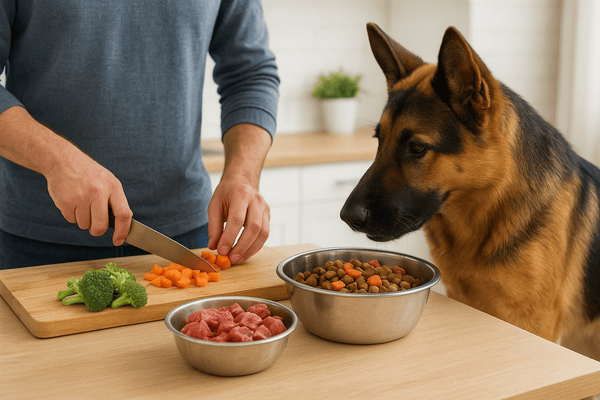
Large breed puppy food — Formulated to support controlled growth with appropriate calcium/phosphorus ratios

Don’t overfeed — Follow feeding guidelines and adjust based on body condition, not the puppy’s appetite

Avoid supplements — Large breed puppy foods already contain proper nutrient ratios. Extra calcium can harm developing bones

Keep them lean — Puppies should be slim with easily felt ribs. Chubby puppies face higher joint disease risk.

Appropriate Exercise During Growth

What’s safe:

  • Controlled leash walks (5 minutes per month of age, twice daily)
  • Free play on soft surfaces (grass, sand)
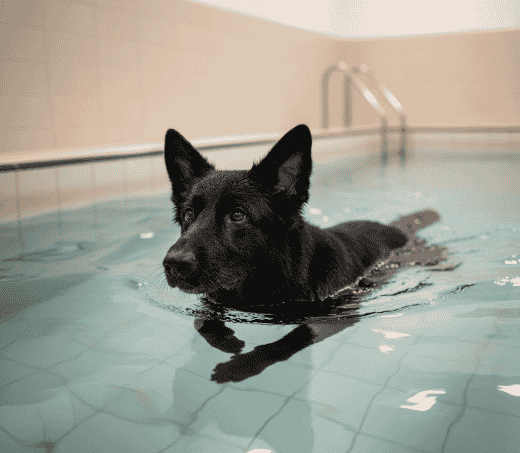
  • Swimming (excellent low-impact exercise)
  • Gentle socialization

What to avoid:

  • Repetitive jumping (on/off furniture, catching frisbees)
  • Running on concrete or pavement
  • Stair climbing (limit significantly)
  • Forced exercise (jogging, biking) before 18 months
  • Rough play with much larger dogs

The goal: Let puppies play naturally but avoid high-impact, repetitive stress on growing joints.

Weight Management

Maintain ideal body condition throughout life:

  • Ribs easily felt but not visible
  • Clear waist when viewed from above
  • Abdominal tuck when viewed from the side

Every extra pound matters — Studies show that even mild overweight increases arthritis risk and severity.

Black-GSD-Swimming-Exercise

Treatment Options for Hip Dysplasia

Treatment depends on severity, the dog’s age, activity level, and pain levels. Most cases are managed conservatively, but severe cases may require surgery.

Conservative (Non-Surgical) Management

Most German Shepherds with mild to moderate hip dysplasia are managed successfully without surgery.

Weight management — This is the single most important factor. Keeping your GSD lean reduces joint stress dramatically.

Controlled exercise — Regular, moderate exercise maintains muscle strength and joint flexibility without causing additional damage.

Physical therapy — Structured exercises, underwater treadmill, therapeutic massage, and stretching improve mobility and reduce pain.

Joint supplements:

Glucosamine and chondroitin — Support cartilage health and may slow degeneration

Omega-3 fatty acids (fish oil) — Reduce inflammation and support joint health

MSM — Natural anti-inflammatory properties

Start supplements early — They work best as prevention rather than treatment after severe arthritis develops

Learn more about the best supplements for German Shepherd joint health

Pain management medication:

NSAIDs (Non-steroidal anti-inflammatory drugs) — Carprofen (Rimadyl), meloxicam (Metacam), deracoxib (Deramaxx)

Gabapentin — For nerve pain associated with arthritis

Adequan injections — Injectable joint protectant that can slow cartilage breakdown

Always under veterinary supervision — Pain medications require monitoring for side effects

Alternative therapies:

Acupuncture — Many dogs respond well to acupuncture for pain management

Laser therapy — Reduces inflammation and pain

Chiropractic care — Can help with compensation issues from altered gait

CBD oil — Some owners report benefits, though research is still emerging (discuss with your vet)


Surgical Options

Surgery is considered for dogs with severe hip dysplasia, young dogs with significant laxity, or those who don’t respond to conservative management.

Juvenile Pubic Symphysiodesis (JPS)

When: Puppies under 20 weeks old
How it works: Alters pelvic growth to improve hip socket depth
Best for: Very young puppies with early-detected laxity
Success rate: High when done at the right age


Double or Triple Pelvic Osteotomy (DPO/TPO)

When: Young dogs (under 10 months) before arthritis develops
How it works: Cuts and rotates pelvic bones to improve socket coverage of the ball
Best for: Young dogs with hip laxity but minimal arthritis
Recovery: 8-12 weeks


Femoral Head Ostectomy (FHO)

When: Any age, especially smaller GSDs or when other options aren’t viable
How it works: Removes the ball of the hip joint; body forms a “false joint” with scar tissue
Best for: Dogs under 50 pounds, severe pain, or as salvage procedure
Pros: Less expensive than total hip replacement, good pain relief
Cons: Not ideal for large, active dogs; range of motion may be limited


Total Hip Replacement (THR)

When: Mature dogs (over 1 year, ideally 18+ months) with severe arthritis
How it works: Replaces the entire hip joint with artificial components
Best for: Large, active dogs with severe hip dysplasia
Pros: Most complete solution; dogs often return to near-normal function
Cons: Most expensive option ($3,000-7,000 per hip); risk of complications; requires strict recovery protocol
Success rate: Very high (90%+) when done by experienced orthopedic surgeons

Hazel’s Perspective:
For Luna, we went the conservative route—weight management, daily supplements, controlled exercise, and NSAIDs as needed during flare-ups. She’s thrived with this approach. But I have friends whose GSDs needed surgery, and they’re also doing wonderfully. The right choice depends entirely on your individual dog.


Living with a Dog with Hip Dysplasia

If your German Shepherd has been diagnosed with hip dysplasia, daily management strategies can maintain quality of life for years.

Home Modifications

Ramps — Use ramps for getting in and out of cars, onto beds, or furniture

Non-slip surfaces — Rugs, yoga mats, or runners on slippery floors prevent falls

Raised food and water bowls — Reduces strain when eating and drinking

Orthopedic dog bed — Supportive memory foam bed reduces pressure on joints

Avoid stairs when possible — If stairs are unavoidable, consider a support harness.

GSD-using-ramp-to-car

Exercise Guidelines

Low-impact activities:

  • Swimming (best exercise for hip dysplasia)
  • Controlled leash walks on soft surfaces
  • Gentle fetch on grass
  • Slow-paced hiking on even terrain

Avoid:

  • Jumping
  • Rough play with other dogs
  • Running on hard surfaces
  • Long hikes or runs
  • Anything that causes limping or stiffness

Warm-up and cool-down — Gentle walking before and after exercise helps prevent stiffness

Consistency — Regular moderate exercise is better than weekend warrior activity

Pain Management

Watch for signs of discomfort:

  • Reluctance to move
  • Stiffness after rest
  • Limping
  • Decreased appetite
  • Changes in behavior (irritability, withdrawal)

When to medicate:

  • Before anticipated activity (walks, vet visits)
  • During weather changes (many dogs with arthritis are sensitive to cold, damp weather)
  • When signs of pain appear

Don’t wait until pain is severe — Proactive pain management keeps dogs more comfortable and active


Long-Term Prognosis

The outlook for German Shepherds with hip dysplasia varies widely depending on severity and management.

Mild Hip Dysplasia

Prognosis: Excellent with proper management
Many dogs live normal lifespans with minimal symptoms
Key factors: Maintain ideal weight, regular exercise, joint supplements, pain management as needed

Moderate Hip Dysplasia

Prognosis: Good to fair with conservative management or surgery
Arthritis will likely develop but can be managed effectively
Quality of life: Most dogs remain comfortable with proper care

Severe Hip Dysplasia

Prognosis: Fair; often requires surgery for best outcome
Without surgery: Chronic pain likely, mobility significantly impaired
With surgery (THR): Many dogs return to near-normal function

The bottom line: Hip dysplasia is manageable. With proper care, most German Shepherds with hip dysplasia live happy, comfortable lives.


Common Questions About Hip Dysplasia

Can hip dysplasia be cured?

No, hip dysplasia cannot be cured—it’s a structural problem with how the joint formed. However, it can be managed effectively, and in some cases, surgery (like total hip replacement) can restore near-normal function.

At what age does hip dysplasia appear?

Signs can appear as early as 5-6 months, though many dogs don’t show symptoms until 1-2 years old. Some dogs with mild dysplasia never show symptoms at all.

Should I still exercise my dog with hip dysplasia?

Yes! Controlled, low-impact exercise is essential. It maintains muscle strength, which supports the joint, and prevents obesity. Swimming is ideal.

Will my dog need surgery?

Most dogs with hip dysplasia are managed conservatively without surgery. Surgery is typically reserved for severe cases or when conservative management isn’t providing adequate pain relief.

Can diet help hip dysplasia?

Diet can’t reverse hip dysplasia, but maintaining a lean body weight is the most important thing you can do to reduce joint stress. Joint supplements (glucosamine, fish oil) may also help slow progression.

Should I breed a dog with hip dysplasia?

No. Hip dysplasia is highly heritable. Breeding dogs with dysplastic hips passes the condition to offspring and perpetuates the problem in the breed.


Final Thoughts

Hip dysplasia is scary when you first hear the diagnosis. I remember sitting in my vet’s office, looking at Luna’s X-rays, feeling like I’d failed her somehow.

But here’s what I learned: hip dysplasia isn’t the end of your dog’s active, happy life. It’s a condition that requires management, attention, and care—but German Shepherds are resilient, and with the right approach, they adapt beautifully.

Luna taught me that. She doesn’t know she has hip dysplasia. She knows she loves swimming, gentle walks in the woods, and chasing tennis balls on the grass. She knows she’s comfortable, loved, and living her best life.

That’s what proper management gives you—not a cure, but a life full of joy, movement, and comfort.

If your German Shepherd has been diagnosed with hip dysplasia, you’re not alone. Thousands of GSD owners are walking this same path, and with knowledge, proactive care, and a good partnership with your vet, your dog can thrive.

Want to support your GSD’s joint health from the start?
Check out our guide to the Best Supplements for German Shepherds—including glucosamine, fish oil, and joint-support formulas that actually work.


More German Shepherd Health Guides

Explore all our GSD health resources →


Trusted Resources


Has your German Shepherd been diagnosed with hip dysplasia? What management strategies have worked best for you? Share your experience in the comments to help other GSD owners navigating this journey.

By Hazel Sloane

Is your German Shepherd constantly scratching, developing bald spots, or showing red, inflamed skin? Discover the causes, symptoms, and proven treatments that actually work.


Is your German Shepherd constantly scratching? Chewing their paws until they’re raw? Waking you up at night because they can’t stop licking their belly?

I know how heartbreaking it is to watch your GSD suffer from skin issues. The constant itching, the red inflamed patches, the bald spots that seem to appear overnight—it’s distressing for both of you.

Skin allergies are one of the most common health problems German Shepherds face. The good news? Most cases are manageable once you identify the cause and find the right treatment approach.

I’ve dealt with allergy issues in my own German Shepherds over the years, and I’ve learned that patience, observation, and sometimes a bit of trial and error are key to finding relief. Let me walk you through everything you need to know about GSD skin allergies—from identifying symptoms to long-term management strategies that actually work.


Why German Shepherds Are Prone to Skin Allergies

German Shepherds rank among the breeds most susceptible to allergies and sensitive skin issues. It’s not bad luck—there are real reasons why GSDs struggle more than other breeds.

Genetic Predisposition

Allergies often run in family lines. If a German Shepherd’s parents or grandparents had allergy issues, there’s a higher chance their offspring will too. Responsible breeders screen for this, but it’s not always preventable.

The Double Coat Factor

That thick, beautiful double coat that makes German Shepherds so striking? It can also trap allergens—pollen, dust, mold spores—right against their skin. While their dense undercoat helps with temperature regulation, it can also create the perfect environment for allergens to accumulate and cause reactions.

Immune System Sensitivity

Dogs with allergies have immune systems that overreact to substances that shouldn’t be threatening. Their bodies release histamines and other chemicals in response to triggers, leading to inflammation, itching, and all the symptoms we’ll discuss next.

Understanding that your GSD’s allergies aren’t a sign of poor breeding or your failure as an owner is important. Allergies are complex, multifactorial issues that many wonderful, healthy German Shepherds experience.


Common Signs Your GSD Has Skin Allergies

Catching allergy symptoms early can prevent secondary infections and help your dog feel better faster. Here’s what to watch for:

Visible Symptoms

Excessive scratching, licking, or biting at skin — If your GSD is constantly working at their skin, something’s bothering them. Pay attention to which areas they target most.

Red, inflamed skin — Check the belly, paws, ears, armpits, and groin area. These spots often show irritation first because the skin is thinner and more sensitive.

Bald spots or thinning fur — Hair loss from constant scratching or licking. These patches may be circular or irregular, and the skin underneath often looks irritated.

Hot spots — Moist, red, painful patches that appear suddenly. These are areas where your dog has licked or chewed so much that the skin becomes infected.

Scabs, crusty skin, or oozing sores — Signs that the skin barrier has been damaged and possibly infected.

Darkened skin (hyperpigmentation) — Chronic inflammation can cause the skin to thicken and darken, especially in areas of repeated irritation.

Thickened, elephant-like skin texture — Long-term allergies can cause the skin to become leathery and rough.

Gsd-sick-behavior

Behavioral Signs

Restlessness or inability to settle — A dog who can’t get comfortable because they’re itchy will pace, shift positions constantly, or have trouble sleeping.

Rubbing face or body against furniture — Trying to scratch hard-to-reach spots or relieve itching.

Head shaking or ear scratching — Ear infections are incredibly common in German Shepherds with allergies.

Paw chewing — Especially between the toes, where moisture and allergens can get trapped.

“Scooting” rear end on the floor — Can indicate allergies, anal gland issues, or parasites.

Secondary Issues

Unpleasant odor — A yeasty, musty smell often indicates a yeast infection secondary to allergies.

Chronic ear infections — If your GSD gets ear infections repeatedly, allergies are likely the underlying cause.

Skin infections — Scratching damages the skin barrier, allowing bacteria and yeast to move in.

Hazel’s Observation:
One of my German Shepherds would start obsessively licking her paws in early spring—that was always my first clue that allergy season was ramping up. Learning your dog’s early warning signs helps you intervene before things get severe.


The 4 Main Types of Skin Allergies in German Shepherds

Understanding which type of allergy your GSD has is crucial for effective treatment. Here are the four most common categories:

A. Food Allergies

Food allergies occur when your dog’s immune system identifies a specific ingredient—usually a protein—as a threat and launches an inflammatory response.

Most common food allergens for dogs:

  • Beef
  • Chicken
  • Dairy products
  • Wheat
  • Corn
  • Soy
  • Eggs

How food allergies present:

  • Year-round symptoms (no seasonal pattern)
  • Itching, especially around the face, ears, paws, and rear end
  • Chronic ear infections
  • Gastrointestinal issues (diarrhea, vomiting, gas)
  • Skin infections

Important distinction: Food allergies are different from food intolerances. An intolerance causes digestive upset but doesn’t involve the immune system. True food allergies cause immune reactions that manifest as skin and ear problems.

The gold standard for diagnosing food allergies is an elimination diet trial, which we’ll cover in detail later. Blood tests for food allergies exist but aren’t considered reliable by most veterinary dermatologists.


B. Environmental Allergies (Atopy)

Environmental allergies — also called atopic dermatitis — are reactions to inhaled or contact allergens in your dog’s surroundings.

Common environmental allergens:

  • Pollen (trees, grass, weeds)
  • Dust mites
  • Mold spores
  • Dander from other animals

Seasonal vs. year-round patterns:

  • Spring allergies: tree pollen
  • Summer allergies: grass pollen
  • Fall allergies: weed pollen, mold
  • Year-round: dust mites, indoor mold, other household allergens

German Shepherds with environmental allergies almost always develop chronic ear infections. If your GSD has recurring ear problems, environmental allergies are likely involved.

Hazel’s Experience:
My older GSD had terrible spring allergies. Every April like clockwork, the paw licking would start, followed by ear infections within a week or two. Once I recognized the pattern, I could start preventive treatment early.


C. Flea Allergy Dermatitis (FAD)

Flea allergy dermatitis is the most common allergy in dogs. It’s not the flea itself that causes the problem,it’s an allergic reaction to proteins in flea saliva.

Here’s the frustrating part: it only takes one flea bite to trigger a reaction that lasts for weeks. You don’t need a flea infestation for your dog to suffer from FAD.

Where symptoms appear:

  • Base of the tail
  • Rear end and back legs
  • Inner thighs
  • Lower back

What to look for:

  • Intense itching in the areas listed above
  • Hair loss and red, irritated skin
  • Small scabs (called “flea dirt”)
  • Obsessive biting at the tail base

Even if you don’t see fleas on your dog, they could still be the problem. Fleas jump on, bite, and jump off. You might never catch them in the act.

How to check for fleas:

  1. Use a flea comb, especially around the tail base and neck
  2. Look for “flea dirt” (black specks that turn red when wet—that’s digested blood)
  3. Check your dog’s bedding for signs of fleas

The solution? Year-round flea prevention for ALL pets in your household, even if they’re indoor-only. We’ll cover specific products later.


D. Contact Allergies

Contact allergies are the least common type but still worth understanding. These occur when your dog’s skin reacts to something they physically touch.

Possible triggers:

  • Grass, plants, or weeds
  • Cleaning products or detergents
  • Shampoos or grooming products
  • Fabrics (carpets, bedding)
  • Chemicals (lawn treatments, de-icing salt)

How contact allergies present:

  • Symptoms appear where the dog had contact with the allergen
  • Common areas: belly, paws, face (if rubbing against something)
  • Less likely to cause ear infections than other allergy types

Contact allergies are diagnosed through process of elimination—literally removing potential triggers one at a time and watching for improvement.

vet-handling-gsd-sick behavior

When to See a Vet (And What Tests They’ll Run)

Some allergy issues you can manage at home, but others require professional help. Here’s when it’s time to make an appointment:

See your vet if:

  • Symptoms have lasted more than a week without improvement
  • The itching is so severe your dog can’t sleep or function normally
  • You see open sores, bleeding, or signs of infection (oozing, foul smell)
  • Bald spots are spreading rapidly
  • Your dog seems miserable or is in obvious pain
  • Home treatments haven’t helped
  • You’re not sure what’s causing the problem

What to Expect at the Vet Visit

Your vet will likely perform several diagnostic tests to identify the cause and rule out other conditions:

1. Skin scraping — Rules out mange mites (sarcoptic or demodectic)

2. Cytology — A quick test where the vet presses tape or a slide against the skin to check for yeast or bacterial infections under a microscope

3. Fungal culture — Rules out ringworm, which can look similar to allergies

4. Allergy testing — Blood tests or intradermal (skin prick) testing to identify environmental allergens. These tests are most useful if you’re considering immunotherapy.

5. Elimination diet trial — The only reliable way to diagnose food allergies

Cost transparency:
Basic vet visits for allergies typically run $75-150 for the exam plus $50-200 for diagnostic tests. Treatment costs vary widely depending on what’s needed—anything from $30/month for antihistamines to $200+/month for advanced medications like Apoquel or Cytopoint.

Treatment timeline:
Allergies rarely resolve overnight. Expect to wait 2-4 weeks to see significant improvement, and some treatments (like food trials or immunotherapy) take months to show full results.

Hazel’s Reality Check:
I spent months and several hundred dollars figuring out that one of my GSDs had chicken allergies. It was frustrating, but the relief on her face once we got it right was worth every penny and every vet visit.


How to Fix Food Allergies in German Shepherds

If your vet suspects food allergies, an elimination diet trial is the most reliable diagnostic and treatment approach.

The Elimination Diet Process

Step 1: Choose a Novel Protein Diet (8-12 weeks)

A “novel protein” is a protein source your dog has never eaten before. The idea is to feed only that protein and a single carbohydrate source for at least 8 weeks while monitoring symptoms.

Novel protein options:

  • Venison
  • Duck
  • Kangaroo
  • Rabbit
  • Salmon
  • Bison

You have two choices:

Option A: Limited ingredient commercial food
Look for veterinary prescription diets or high-quality limited ingredient foods with a single novel protein and carb source.

Option B: Homemade diet
Cook meals using the novel protein and a safe carbohydrate (like sweet potato). If you go this route, work with your vet or a veterinary nutritionist to ensure the diet is balanced.

Critical rules during the trial:

  • No treats unless they’re made from the same protein
  • No table scraps
  • No flavored medications (ask your vet for unflavored versions)
  • No rawhides, bully sticks, or dental chews
  • Everyone in the household must follow the rules (one slip-up can ruin the trial)

This is where most people fail. It requires discipline, but it’s the only way to know for sure.

Diet plays a huge role in skin health.
Learn exactly what to feed your German Shepherd in our Complete GSD Food Guide — including foods that support healthy skin and reduce inflammation.


Step 2: Monitor Symptoms

Keep a journal or take weekly photos. Track:

  • Itching intensity (scale of 1-10)
  • Areas of redness or irritation
  • Ear condition
  • Energy level and behavior
  • Any digestive changes

Most dogs with food allergies will show improvement within 4-8 weeks if you’ve identified and removed the trigger.

Step 3: Food Challenge

Once your dog has been symptom-free for several weeks on the elimination diet, it’s time to identify which foods are safe.

Reintroduce one protein at a time (for example, add chicken back in for 2 weeks). If symptoms return, you’ve identified a trigger. If symptoms don’t return, that food is safe.

Continue this process until you’ve tested all the proteins you want to feed.

Long-Term Management

Once you know which foods cause reactions:

  • Stick with safe proteins
  • Read ingredient labels carefully (chicken can hide in unexpected places)
  • Consider hydrolyzed protein diets if your dog reacts to multiple proteins

What to look for in limited ingredient foods:

  • Named meat as the first ingredient
  • Single protein and carb source
  • No common allergens (no chicken, beef, dairy, wheat, corn, soy)
  • No artificial additives or fillers

Managing Environmental Allergies

Environmental allergies can’t be “cured,” but they can absolutely be managed. Here’s how:

Immediate Relief Strategies

Wipe paws and body after walks
Use unscented baby wipes or a damp cloth to remove pollen and other allergens before they have a chance to cause problems. Focus on paws, belly, and face.

Bathe weekly during allergy season
Regular baths with a hypoallergenic or medicated shampoo can remove allergens from the coat and soothe irritated skin. Don’t overdo it outside of allergy season, though—too much bathing strips natural oils.

HEPA air filters
Run HEPA filters in rooms where your dog spends the most time. They capture airborne allergens like pollen, dust, and dander.

Wash bedding frequently
Launder your dog’s bedding in hot water weekly to remove accumulated allergens.

Keep windows closed during high pollen days
Check your local pollen forecast and keep your dog indoors with windows closed when counts are high.

🐕 Reduce allergens with proper grooming.
Our German Shepherd Shedding: Complete Survival Guide shows you how to minimize allergen buildup through smart brushing routines and coat maintenance.


Medical Management Options

Antihistamines
Over-the-counter antihistamines can help mild to moderate allergies. Options include:

  • Benadryl (diphenhydramine): 1mg per pound of body weight, 2-3 times daily
  • Zyrtec (cetirizine): 0.5mg per pound once daily
  • Claritin (loratadine): 0.25mg per pound once or twice daily

Always check with your vet before giving any medication. Some dogs respond well to antihistamines, others see no benefit.

Apoquel (prescription)
A prescription medication that blocks the itch signal at the source. It works quickly (often within hours) and is effective for most dogs. Used for short-term or long-term management.

Cytopoint (prescription injections)
A monthly injection that neutralizes the protein responsible for itching. Each injection lasts 4-8 weeks. Great for dogs who can’t take oral medications or whose owners struggle with daily pills.

Steroids (short-term only)
Prednisone and other steroids are highly effective for stopping itching and inflammation, but they come with side effects (increased thirst, appetite, and urination; long-term use can cause more serious issues). Vets use these for short-term relief or when nothing else works.

Immunotherapy / Allergy Shots
If you’ve done allergy testing and identified specific triggers, your vet can create custom allergy shots that gradually desensitize your dog’s immune system. This is a long-term solution (takes 6-12 months to see results) but can be life-changing for dogs with severe environmental allergies.

Natural Supplements That Help

Omega-3 fatty acids (fish oil)
Anti-inflammatory properties support skin health and can reduce itching. Look for high-quality fish oil with EPA and DHA. Typical dosage: 20-55mg of combined EPA/DHA per pound of body weight daily.

Quercetin
Often called “nature’s Benadryl,” quercetin is a natural antihistamine found in certain plants. Some dogs respond well to it as a supplement.

Probiotics
A healthy gut supports a healthy immune system. Probiotic supplements can help some dogs with allergy management.

Colostrum
Contains immune-modulating compounds that may help with allergies and gut health.

When each option makes sense:

  • Mild allergies: Try antihistamines and omega-3s first
  • Moderate allergies: Add in Apoquel or Cytopoint
  • Severe allergies: Combination approach + possibly immunotherapy
  • Budget-conscious: Start with antihistamines, environmental management, and diet optimization
*Dog owner preparing-healthy -food-homemade food for German Shepherd with chicken, rice, and vegetables*

Treating Flea Allergies

If your German Shepherd has flea allergy dermatitis, prevention is absolutely everything. Even one flea bite can trigger weeks of misery.

Year-Round Flea Prevention

This is non-negotiable. Even if you live in a cold climate, fleas can survive indoors year-round.

Prescription options (most effective):

  • Oral medications: Simparica, NexGard, Bravecto, Credelio
  • Topical medications: Revolution Plus, Advantage Multi

Over-the-counter options (less reliable):

  • Frontline, Advantage II

Prescription products are significantly more effective than OTC options. They kill fleas faster and provide better protection.

Treat ALL pets in the household — If you have multiple dogs or cats, everyone needs flea prevention. Otherwise, you’ll have a never-ending cycle of reinfestation.

Environmental Treatment

If you’ve discovered fleas in your home:

  1. Vacuum thoroughly — Floors, furniture, baseboards, cracks. Dispose of the vacuum bag immediately.
  2. Wash all bedding — Dog beds, human bedding, blankets, anything your dog has contact with. Hot water and high heat in the dryer.
  3. Treat your yard — Flea sprays or professional pest control for outdoor areas where your dog spends time.
  4. Consider professional pest control — For severe infestations, this might be necessary.

If Your GSD Already Has FAD

  • Start flea prevention immediately
  • Give anti-itch medication for relief (Apoquel, Cytopoint, or short-term steroids)
  • Address secondary skin infections with antibiotics or antifungal medications if needed
  • Use an e-collar if your dog is making the irritation worse by licking or chewing

Hazel’s Tip:
I keep my GSDs on year-round prescription flea prevention. It’s expensive, but it’s cheaper than treating flea allergies and infinitely better for my dogs’ quality of life.


Home Remedies & Soothing Solutions

Sometimes you need quick relief while waiting for medications to work or vet appointments to happen. Here are safe, vet-approved options:

For Immediate Itch Relief

Oatmeal baths
Colloidal oatmeal (finely ground oats) soothes inflamed skin. You can buy pre-made oatmeal shampoos or make your own by grinding plain oats in a blender and mixing with warm water. Let your dog soak for 10-15 minutes.

Apple cider vinegar rinse
Dilute apple cider vinegar 50/50 with water and use as a final rinse after bathing. It has antibacterial and antifungal properties and can soothe itchy skin. Don’t use on open wounds or raw skin—it will sting.

Coconut oil (topically)
A thin layer of coconut oil can moisturize dry, flaky skin. Use sparingly—too much can make a mess and potentially cause stomach upset if your dog licks it off.

Cold compresses
For hot spots or localized irritation, a cold, damp cloth can provide immediate relief and reduce swelling.

E-collar (cone of shame)
If your dog is making things worse by constant licking or chewing, an e-collar prevents further damage and allows the skin to heal.

What NOT to Use

Tea tree oil — Toxic to dogs in concentrated form. Avoid it.

Human lotions or creams — Many contain zinc, fragrances, or medications that are harmful if ingested.

Alcohol or hydrogen peroxide on open wounds — These damage healthy tissue and slow healing. Use only if your vet specifically recommends it.

DIY Anti-Itch Spray

Ingredients:

  • 1 cup water
  • 1 tablespoon apple cider vinegar
  • 1 tablespoon aloe vera gel (100% pure, no additives)

Mix in a spray bottle and mist onto irritated areas (avoid face and open wounds). Store in the fridge for up to a week.

When to use:
Between baths or vet visits for mild itching. Not a substitute for veterinary care if symptoms are severe.

GSD-Bathing

Preventing Skin Infections (Secondary Issues)

Allergies don’t just cause itching—they often lead to secondary bacterial or yeast infections that make everything worse.

Why Allergies Lead to Infections

When your dog scratches, licks, or chews at their skin, they damage the protective skin coat. Bacteria and yeast that normally live on the skin surface can then move into the damaged tissue and multiply.

Moisture, warmth, and inflammation create the perfect environment for these organisms to thrive. Once an infection sets in, itching intensifies, your dogi scratches more, and the cycle continues.

Signs of Secondary Infection

  • Foul odor (especially a yeasty, musty smell)
  • Oozing or crusty lesions
  • Increased redness and swelling
  • Pain when you touch affected areas
  • Fever or lethargy

Treatment

Bacterial infections:

Yeast infections:

  • Antifungal medications (oral or topical)
  • Medicated shampoos containing ketoconazole or miconazole

General care:

  • Keep affected areas clean and dry
  • Use an e-collar to prevent licking
  • Follow your vet’s instructions completely—stopping antibiotics early can lead to resistant infections

Prevention

The best way to prevent infections is to address the underlying allergies before skin damage occurs. Regular skin checks, early intervention, and proper allergy management keep secondary infections at bay.


Long-Term Allergy Management Plan

Allergies are rarely a one-time problem. Most German Shepherds with allergies need ongoing management. Here’s how to create a sustainable routine:

Daily

  • Wipe paws and belly after outdoor time (especially during allergy season)
  • Check skin during petting or playtime—look for new hot spots, redness, or irritation
  • Administer any medications or supplements as prescribed

Weekly

  • Thorough skin inspection (lift fur and check areas prone to problems)
  • Bath if needed during heavy allergy season
  • Wash dog bedding in hot water

Monthly

  • Administer flea prevention (mark it on your calendar so you don’t forget)
  • Deep clean living spaces—vacuum thoroughly, wash any fabric your dog contacts
  • Review food ingredients if feeding commercial food (manufacturers sometimes change formulas)

Seasonally

  • Adjust routine based on allergy triggers (increase bathing frequency in spring if pollen is the issue)
  • Stock up on supplies before peak allergy season hits
  • Schedule a vet check-up if symptoms typically worsen during certain times of year

Keep a Health Journal

Track symptoms, triggers, what works, and what doesn’t. This information is invaluable when working with your vet and helps you identify patterns over time.

What to record:

  • Date and symptoms observed
  • Environmental factors (pollen count, new detergent, different food)
  • Treatments tried and results
  • Vet visit notes and medication changes

Common Mistakes GSD Owners Make

Even with the best intentions, it’s easy to make mistakes when managing allergies. Avoid these common pitfalls:

1. Waiting too long to see a vet
Hoping it will resolve on its own just allows your dog to suffer longer and increases the risk of secondary infections.

2. Inconsistent treatment
Stopping medications as soon as symptoms improve often leads to relapse. Follow your vet’s instructions completely, even if your dog seems better.

3. Not treating all pets for fleas
If you have multiple pets and only treat one, fleas will continue to thrive on the untreated animals and reinfest your dog.

4. Giving table scraps during an elimination diet trial
One piece of chicken can ruin months of effort. Everyone in your household must be on board.

5. Using human products on dog skin
Dogs lick their skin constantly. What’s safe for human skin isn’t always safe for dogs to ingest.

6. Over-bathing
Bathing too frequently strips natural oils and can actually worsen dry, itchy skin. Follow appropriate bathing guidelines for German Shepherds.

7. Ignoring ear infections
Chronic ear infections are often a sign of allergies. Treating the ears without addressing the underlying allergy means they’ll keep coming back.

8. Not reading food labels carefully
Allergens can hide in treats, dental chews, and even some medications. Always read ingredient lists.


When Allergies Might Be Something Else

Sometimes what looks like allergies is actually a different condition entirely. If your dog’s symptoms don’t respond to typical allergy treatments, consider these possibilities:

Conditions That Mimic Allergies

Mange (mites)
Both sarcoptic mange (scabies) and demodectic mange cause intense itching and hair loss. Diagnosed with a skin scraping.

Ringworm
A fungal infection that causes circular areas of hair loss. Not actually a worm — it’s a fungus. Diagnosed with a fungal culture.

Autoimmune diseases
Conditions like pemphigus cause skin lesions and blistering. These require specific testing and treatment.

Hormonal imbalances
Hypothyroidism (low thyroid) and Cushing’s disease can cause skin and coat problems. Diagnosed with blood tests.

Nutritional deficiencies
Lack of essential fatty acids or other nutrients can cause poor coat quality and skin issues.

Red Flags That It’s NOT Allergies

  • Sudden onset in an older dog with no previous history
  • Symptoms don’t respond at all to typical allergy treatments
  • Rapid progression or signs of systemic illness (fever, weight loss, lethargy)
  • Skin lesions that look unusual (blisters, ulcers, thick crusts)

When in doubt, see your vet. Proper diagnosis is essential for effective treatment.


Final Thoughts

keeping life with a German Shepherd who has skin allergies isn’t easy. The constant scratching, the vet visits, the trial and error—it can be exhausting and emotionally draining.

But here’s what I want you to know: most allergy cases are manageable. With the right approach, patience, and partnership with your veterinarian, your GSD can be comfortable and happy.

It might take time to figure out what works for your specific dog. You might try several treatments before finding the right combination. That’s normal. Don’t give up.

Your German Shepherd depends on you to advocate for them, to notice when something’s wrong, and to keep searching for solutions even when it’s frustrating. The fact that you’re reading this article tells me you’re already doing that.

Pay attention to your dog’s patterns. Keep records. Communicate clearly with your vet. Be consistent with treatments. And give yourself grace when things don’t go perfectly.

Your GSD’s comfort and quality of life are worth the effort. And when you finally see them sleeping peacefully instead of scratching all night, or playing joyfully instead of obsessively licking their paws, you’ll know every vet visit and every lifestyle adjustment was worth it.

More German Shepherd Health Guides:

Browse all our GSD care guides →


Trusted Resources


Has your German Shepherd dealt with skin allergies? Share your experience in the comments below — what worked for your GSD? Other owners would love to hear your story!
By Hazel Sloane

German Shepherds shed a lot. Here’s everything you need to know about managing GSD shedding, from the best tools to daily routines that actually work.


If you own a German Shepherd, you’ve made peace with one undeniable truth: fur is now a permanent part of your life.

It’s on your clothes, your furniture, your car seats, and somehow—inexplicably—inside your kitchen cabinets. You’ve probably vacuumed three times this week and still found tumbleweeds of fur rolling across your floor like tiny, fluffy ghosts.

German Shepherds are incredible dogs, but they are professional shedders. It’s not a flaw—it’s just part of the package. The good news? With the right tools, routines, and expectations, you can manage the shedding without losing your mind.

Let me walk you through everything I’ve learned over the years about keeping German Shepherd shedding under control.


Why German Shepherds Shed So Much

German Shepherds have a double coat, which means they have two layers of fur working together:

1. The Outer Coat (Guard Hairs)

This is the longer, coarser layer you see on the surface. It’s designed to protect your dog from dirt, moisture, and UV rays. Guard hairs are relatively weather-resistant and give your GSD that classic, sleek look.

2. The Undercoat (Soft, Dense Fur)

Beneath the guard hairs is a thick, fluffy undercoat that provides insulation. In winter, this layer keeps your dog warm. In summer, it helps regulate body temperature by trapping cool air close to the skin.

Unlike single-coated breeds (think Poodles or Greyhounds), German Shepherds shed year-round. But twice a year, during spring and fall, they go through a major shedding event called “blowing their coat,” and that’s when things get really intense.

Hazel’s Reality Check:
I’ve had German Shepherds my entire adult life, and I’ve learned to embrace the fur. It’s not going away. But with a solid routine, you can keep it manageable instead of overwhelming.


Shedding Seasons: What to Expect

German Shepherds shed consistently throughout the year, but their shedding intensifies dramatically twice a year.

Spring Shedding (March–May)

In spring, your GSD sheds their thick winter undercoat to prepare for warmer weather. This is often the heaviest shedding season. You’ll notice massive clumps of soft, fluffy fur coming out in your hands when you brush them.

During this time, daily brushing isn’t optional—it’s survival.

Fall Shedding (September–November)

In fall, your German Shepherd sheds their lighter summer coat and grows in a thicker undercoat for winter. This shedding event is usually less dramatic than spring, but it’s still significant.

Year-Round Shedding

Even outside of blowout seasons, German Shepherds shed daily. You’ll find fur on your clothes, furniture, and floors no matter what time of year it is. That’s just life with a double-coated breed.


Is My German Shepherd Shedding Too Much?

Shedding is normal, but excessive shedding can sometimes signal a health issue. Here’s how to tell the difference:

Normal Shedding Looks Like:

  • Consistent, moderate shedding year-round
  • Heavier shedding in spring and fall
  • Fur comes out easily when you brush
  • Your dog’s coat still looks full and healthy
  • No bald patches or thinning areas

Excessive or Abnormal Shedding Looks Like:

  • Sudden, dramatic increase in shedding outside of seasonal changes
  • Bald spots or patchy fur loss
  • Red, irritated, or flaky skin underneath
  • Your dog is constantly scratching or biting at their coat
  • Dull, dry, or brittle fur texture

If your German Shepherd’s shedding seems abnormal, it could be caused by:

  • Poor nutrition (low-quality food lacking essential fatty acids)
  • Allergies (food allergies or environmental triggers)
  • Skin infections (bacterial or fungal)
  • Parasites (fleas, mites, or ticks)
  • Stress or anxiety
  • Hormonal imbalances (thyroid issues, Cushing’s disease)

When in doubt, check with your vet. Sudden changes in shedding patterns are worth investigating.


The Best Deshedding Tools for German Shepherds

Not all brushes are created equal. Here’s what actually works for managing GSD shedding:

1. Undercoat Rake

This is your number one weapon against shedding. An undercoat rake has long, spaced-out teeth designed to reach through the guard hairs and pull out loose undercoat without damaging the topcoat.

When to use it: Daily during shedding season, 2-3 times per week otherwise.

Hazel’s Pick:
I swear by a good undercoat rake during spring blowouts. You’ll be shocked at how much fur comes out in a single session.

2. Slicker Brush

A slicker brush has fine, short wires close together. It’s great for removing loose fur from the surface and keeping the coat smooth and tangle-free.

When to use it: After using the undercoat rake, or for quick daily touch-ups.

3. Deshedding Tool (Like a FURminator)

Deshedding tools have a fine-toothed blade that grabs and removes loose undercoat. They’re incredibly effective but should be used carefully—over-brushing can irritate your dog’s skin.

When to use it: Once or twice a week during heavy shedding seasons. Avoid using it more than necessary.

Hazel’s Tip:
Don’t press too hard with a deshedding tool. Let the tool do the work. If you’re applying pressure, you’re doing it wrong.

German Shepherd grooming tools

4. Pin Brush

A pin brush has rounded tips and is gentler than a slicker brush. It’s good for general grooming and distributing natural oils through the coat.

When to use it: For everyday brushing or for dogs with sensitive skin.

5. Grooming Glove

A rubber grooming glove lets you “pet” your dog while removing loose fur. It’s less effective than dedicated tools but great for dogs who don’t love being brushed.

When to use it: As a supplementary tool or for quick touch-ups.


Daily Brushing Routine That Actually Works

Here’s the routine I follow with my German Shepherds, and it’s kept the fur situation under control for years:

brshing-GSD

During Shedding Season (Spring & Fall):

Daily Routine (10-15 minutes):

  1. Start with the undercoat rake — Work in sections, brushing in the direction of fur growth. Focus on areas where the undercoat is thickest: the back, sides, chest, and haunches.
  2. Follow up with a slicker brush — Smooth out the topcoat and catch any remaining loose fur.
  3. Check for mats or tangles — Pay special attention to behind the ears, under the legs, and around the tail.
  4. Reward your dog — Make brushing a positive experience with treats or praise.

During Normal Shedding (Rest of the Year):

2-3 Times Per Week (5-10 minutes):

  1. Use the undercoat rake or slicker brush to remove loose fur.
  2. Keep sessions short and positive.
  3. Watch for any skin irritation or unusual shedding patterns.

Hazel’s Secret:
I brush my GSDs outside whenever possible. It keeps the fur tumbleweeds from invading my house, and the dogs seem to enjoy being outdoors during grooming time.


Diet & Supplements That Reduce Shedding

You can’t stop a German Shepherd from shedding, but you can improve the health of their coat—and healthy coats shed less excessively.

1. High-Quality Dog Food

Your dog’s diet has a massive impact on coat health. Look for food that:

  • Lists real meat as the first ingredient
  • Contains omega-3 and omega-6 fatty acids
  • Avoids fillers like corn, wheat, and soy
  • Includes vitamins A and E for skin and coat health

If your GSD’s coat looks dull, dry, or brittle, diet is often the culprit.

2. Omega-3 Fatty Acid Supplements (Fish Oil)

Omega-3s support skin health, reduce inflammation, and promote a shiny, healthy coat. Many German Shepherds benefit from a daily fish oil supplement, especially if their food doesn’t already include it.

Dosage: Follow the product instructions based on your dog’s weight, or consult your vet.

3. Coconut Oil

A small amount of coconut oil (about 1 teaspoon per 10 pounds of body weight) can support coat health when added to food. It also has antibacterial and anti-inflammatory properties.

Hazel’s Tip:
I add a teaspoon of fish oil to my dogs’ meals a few times a week. I’ve noticed their coats are shinier and softer, and shedding seems slightly less intense during blowout season.

4. Stay Hydrated

Dehydration can lead to dry skin and increased shedding. Make sure your German Shepherd always has access to fresh water.


Bathing Schedule for Shed Control

Bathing your German Shepherd can help loosen and remove dead undercoat, but you have to be careful not to overdo it.

How Often Should You Bathe a GSD?

GSD-Bathing

Every 6-8 weeks is ideal for most German Shepherds. Bathing too frequently strips natural oils from the skin and coat, which can actually increase shedding and cause dryness.

Best Bathing Practices for Shedding:

  1. Brush before bathing — Remove as much loose fur as possible first. Wet fur mats easily, and you don’t want to trap dead undercoat against the skin.
  2. Use a deshedding shampoo — Look for shampoos formulated to loosen undercoat and promote healthy skin.
  3. Rinse thoroughly — Leftover shampoo can irritate skin and cause itching, leading to more shedding.
  4. Blow-dry (if possible) — A high-velocity dog dryer can blow out tons of loose undercoat. If you don’t have one, towel-dry thoroughly and brush again once your dog is fully dry.

Hazel’s Bathing Tip:
I bathe my GSDs outdoors in warm weather. It’s easier to manage the fur, and they love being outside. In winter, I use a walk-in shower with a handheld sprayer.


Managing GSD Fur in Your Home

Even with perfect grooming, you’ll still have fur in your house. Here’s how to keep it manageable:

1. Invest in a Good Vacuum

A vacuum designed for pet hair is worth every penny. Look for one with strong suction, a HEPA filter, and attachments for furniture and stairs.

2. Lint Rollers and Pet Hair Removers

Keep lint rollers in every room, your car, and your bag. Rubber pet hair removal brushes are also great for furniture and car seats.

3. Washable Furniture Covers

Protect your couch and chairs with washable, pet-friendly covers. It’s easier to throw a cover in the wash than to deep-clean a couch every week.

4. Regular Laundry Routine

Wash your dog’s bedding, blankets, and any fabric they come in contact with regularly. Add a cup of white vinegar to the rinse cycle to help remove pet hair.

5. Air Purifiers

A HEPA air purifier can help capture airborne fur and dander, which is especially helpful if you or anyone in your household has allergies.

Hazel’s Reality Check:
I’ve accepted that no matter how much I clean, there will always be some fur. I’ve made peace with it. My advice? Wear clothes that match your dog’s coat color. It’s genius.


When Excessive Shedding Signals a Health Problem

If your German Shepherd’s shedding suddenly increases or you notice any of the following, see your vet:

  • Bald patches or uneven hair loss
  • Red, inflamed, or scaly skin
  • Constant scratching, licking, or biting at the coat
  • A strong odor coming from the skin or coat
  • Lethargy or behavior changes alongside shedding

These could be signs of:

  • Allergies (food or environmental)
  • Skin infections (bacterial or fungal)
  • Parasites (fleas, mites)
  • Hormonal imbalances (hypothyroidism, Cushing’s disease)
  • Nutritional deficiencies

Shedding alone isn’t usually a health concern, but when paired with other symptoms, it’s worth investigating.


Hazel’s Complete Weekly Shedding Management Routine

Here’s exactly what I do to keep German Shepherd shedding under control:

During Shedding Season:

  • Daily: 10-15 minutes of brushing with undercoat rake and slicker brush
  • Weekly: Check for mats, tangles, and skin irritation
  • Every 6-8 weeks: Bath with deshedding shampoo
  • Ongoing: Vacuum floors and furniture 3-4 times per week, wash dog bedding weekly

During Normal Months:

  • 2-3 times per week: Brushing session with undercoat rake or slicker brush
  • Every 6-8 weeks: Bath
  • Ongoing: Vacuum 2-3 times per week, wash bedding every other week

Year-Round:

  • Feed high-quality food with omega fatty acids
  • Add fish oil supplement a few times per week
  • Keep lint rollers everywhere
  • Accept that fur is just part of life now

Final Thoughts

German Shepherd shedding is inevitable. You can’t stop it, and honestly, you shouldn’t try. That double coat is doing exactly what it’s designed to do—protecting your dog and regulating their body temperature.

But with the right tools, a consistent grooming routine, and realistic expectations, you can absolutely keep shedding manageable. It doesn’t have to take over your life.

Brush regularly, feed well, and remember: every strand of fur is a reminder of the incredible dog you share your life with. It’s a small price to pay for a German Shepherd’s loyalty, intelligence, and love.

Now go grab that undercoat rake. Your vacuum cleaner will thank you.

out door activities

Trusted Resources


By Hazel Sloane

Wondering if your German Shepherd can have bananas? The answer is yes, but there’s a right way and a wrong way to share them. Plus, discover 15 other safe fruits and veggies your GSD can enjoy.

*Dog owner preparing healthy homemade food for German Shepherd with chicken, rice, and vegetables*

You’re peeling a banana in the kitchen, and suddenly your German Shepherd is at your feet, tail wagging, eyes locked on that yellow fruit like it’s the most fascinating thing they’ve ever seen.

Can you share a piece? Is it safe? Will it upset their stomach?

The short answer: Yes, German Shepherds can absolutely eat bananas. They’re not toxic, and in moderation, they can even be a healthy treat. But like most human foods, there are some guidelines you should follow to keep your GSD safe and healthy.

Let’s break down everything you need to know about feeding bananas to your German Shepherd—plus a bunch of other fruits and vegetables that make excellent, nutritious snacks.


Can German Shepherds Eat Bananas? The Quick Answer

Yes, bananas are safe for German Shepherds. They’re non-toxic, easy to digest, and packed with nutrients that can benefit your dog’s health.

Bananas contain:

  • Potassium (supports heart and muscle function)
  • Vitamin C (boosts immune health)
  • Vitamin B6 (helps with brain development and function)
  • Fiber (aids digestion)
  • Natural sugars (quick energy boost)

That said, bananas are also relatively high in sugar, which means they should be given as an occasional treat—not a daily staple. Too much banana can lead to weight gain, digestive upset, or blood sugar spikes, especially in less active dogs.

Hazel’s Tip:
I give my German Shepherds banana slices as high-value training treats or frozen banana chunks on hot summer days. They love them, and I love that I’m giving them something natural instead of processed snacks.


Health Benefits of Bananas for German Shepherds

When given in moderation, bananas can be a genuinely healthy addition to your GSD’s diet. Here’s what they bring to the table:

1. Natural Energy Boost

The natural sugars in bananas (fructose, glucose, and sucrose) provide quick energy. This makes bananas a great pre-walk or post-exercise snack for active German Shepherds.

2. Supports Digestive Health

Bananas are high in fiber, which can help regulate your dog’s digestive system. If your GSD occasionally has loose stools, a small amount of banana can help firm things up. On the flip side, too much fiber can cause constipation, so balance is key.

3. Heart and Muscle Function

Potassium is essential for heart health and proper muscle function. German Shepherds are active, muscular dogs, and potassium helps keep everything running smoothly.

4. Immune System Support

Vitamin C acts as an antioxidant, supporting your dog’s immune system and helping their body fight off illness and inflammation.

5. Low in Sodium and Cholesterol

Unlike many processed dog treats, bananas are naturally low in sodium and cholesterol, making them a heart-healthy option.


How to Safely Feed Bananas to Your German Shepherd

Just because bananas are safe doesn’t mean you should toss your GSD a whole one and call it a day. Here’s how to do it right:

Portion Size Matters

For an adult German Shepherd, a few slices of banana (about 1-2 inches of a medium banana) is plenty for one serving. Treats—including healthy ones like fruit—should make up no more than 10% of your dog’s daily calorie intake.

Sizing guide:

  • Puppies: 1-2 small slices
  • Adult GSDs: 3-5 slices
  • Senior dogs: 2-3 slices (especially if they’re less active)

Remove the Peel

Banana peels aren’t toxic, but they’re tough to digest and can cause blockages or stomach upset. Always peel the banana before offering it to your dog.

Serve Fresh or Frozen

Bananas can be served fresh, mashed, or frozen. Frozen banana slices make an excellent cooling treat on hot days, and many dogs love the texture.

Avoid Added Ingredients

Never give your German Shepherd banana bread, banana chips, or anything with added sugar, chocolate, or artificial sweeteners (especially xylitol, which is highly toxic to dogs). Plain, fresh banana only.

Introduce Slowly

If your GSD has never had banana before, start with a small piece and watch for any signs of digestive upset (diarrhea, vomiting, excessive gas). Most dogs tolerate bananas well, but it’s always smart to introduce new foods gradually.

can-gsd-eat-banana

When Bananas Are NOT a Good Idea

While bananas are generally safe, there are a few situations where you should skip them:

1. Your Dog Is Diabetic

Bananas are high in natural sugars, which can cause blood sugar spikes. If your German Shepherd has diabetes, consult your vet before offering fruit.

2. Your Dog Is Overweight

The sugar and calorie content in bananas can contribute to weight gain if given too frequently. If your GSD is already carrying extra pounds, opt for lower-calorie treats like green beans or cucumber.

3. Your Dog Has Kidney Issues

Bananas are high in potassium, which can be problematic for dogs with kidney disease. Always check with your vet if your dog has any chronic health conditions.

4. They’ve Already Had Too Many Treats

Remember the 10% rule. If your dog has already had training treats, table scraps, or other snacks that day, skip the banana to avoid overfeeding.


15 Safe Fruits & Vegetables for German Shepherds

Bananas aren’t the only human food your GSD can enjoy. Here are 15 other fruits and veggies that are safe, healthy, and often beloved by German Shepherds:

Fruits

1. Apples (without seeds or core)
Crunchy, hydrating, and full of fiber and vitamin C. Remove the core and seeds, as apple seeds contain small amounts of cyanide.

2. Blueberries
Packed with antioxidants and low in calories. These little berries are a perfect training treat.

3. Strawberries
High in fiber and vitamin C. Serve fresh and in moderation due to sugar content.

4. Watermelon (seedless, no rind)
Super hydrating and low in calories. Great for hot days. Remove all seeds and the rind.

5. Cantaloupe
High in vitamins A and C. Feed in small amounts due to sugar content.

6. Pineapple (fresh only)
Contains bromelain, an enzyme that may help with digestion. Remove the tough core and skin. Skip canned pineapple due to added sugar.

7. Mango (no pit or skin)
Rich in vitamins A, B6, C, and E. The pit is a choking hazard, so always remove it.

8. Pears (no seeds or core)
High in fiber and vitamin C. Remove seeds and core just like with apples.


Vegetables

9. Carrots
Crunchy, low-calorie, and great for dental health. Serve raw or cooked. My GSDs go crazy for frozen carrot sticks as a teething snack.

10. Green Beans
Low in calories and high in fiber. Plain, cooked, or raw green beans are excellent for weight management.

11. Sweet Potatoes (cooked, no seasoning)
Packed with fiber, vitamins A and C, and easy to digest. Never serve raw, as they can be hard on a dog’s stomach.

12. Cucumbers
Extremely low in calories and very hydrating. Perfect for overweight dogs or hot summer days.

13. Broccoli (in small amounts)
High in fiber and vitamin C, but too much can cause gas. Serve in moderation—no more than 10% of your dog’s diet.

14. Pumpkin (plain, canned or cooked)
Excellent for digestive health. Pure pumpkin (not pie filling) can help with both diarrhea and constipation.

15. Zucchini
Low-calorie, mild-flavored, and easy to digest. Serve raw or cooked without seasoning.

Hazel’s Tip:
I keep a bag of frozen blueberries and carrot sticks in the freezer at all times. They’re my go-to training rewards, and my GSDs think they’re getting something special every single time.


10 Toxic Foods to NEVER Feed Your German Shepherd

Just as important as knowing what’s safe is knowing what’s dangerous. Here are the most common toxic foods for dogs:

  1. Grapes and Raisins — Can cause sudden kidney failure, even in small amounts.
  2. Chocolate — Contains theobromine, which is toxic to dogs. Dark chocolate is the most dangerous.
  3. Onions and Garlic — Damages red blood cells and can cause anemia.
  4. Avocado — Contains persin, which can cause vomiting and diarrhea.
  5. Xylitol (artificial sweetener) — Found in sugar-free gum, candy, and peanut butter. Causes rapid insulin release and can be fatal.
  6. Macadamia Nuts — Can cause weakness, vomiting, tremors, and hyperthermia.
  7. Alcohol — Even small amounts can cause serious poisoning.
  8. Coffee and Caffeine — Contains stimulants that are dangerous for dogs.
  9. Raw Dough — Expands in the stomach and produces alcohol as it ferments.
  10. Cooked Bones — Splinter easily and can cause choking or internal damage.

If your German Shepherd eats any of these foods, contact your vet or the Pet Poison Helpline immediately.


Hazel’s Favorite Fruit Treats for GSDs

Over the years, I’ve learned which fruits my German Shepherds go absolutely wild for. Here are my top picks:

1. Frozen Blueberry Training Treats

I freeze fresh blueberries and use them as high-value rewards during training sessions. They’re small, low-calorie, and my dogs work just as hard for them as they would for processed treats.

2. Banana and Pumpkin “Pupsicles”

Blend banana and plain pumpkin with a little water, pour into ice cube trays, and freeze. Perfect for hot days or post-walk cool-downs.

3. Apple Slices with Peanut Butter (xylitol-free!)

Slice an apple, remove the core and seeds, and spread a thin layer of xylitol-free peanut butter on top. My GSDs lose their minds over this combo.

4. Watermelon Chunks

Simple, refreshing, and naturally hydrating. I cut watermelon into bite-sized chunks and serve them cold from the fridge.


How to Introduce New Foods Safely

Whenever you’re offering your German Shepherd a new fruit or vegetable, follow these steps to avoid any stomach upset:

1. Start Small

Offer just a tiny piece literally one small bite. Wait 24 hours to see how your dog’s body reacts.

2. Watch for Symptoms

Keep an eye out for:

  • Vomiting
  • Diarrhea
  • Excessive gas
  • Lethargy
  • Loss of appetite

If any of these occur, stop feeding that food and consult your vet if symptoms persist.

3. Gradually Increase

If your dog tolerates the food well, you can slowly increase the portion size over the next few days.

4. Keep a Food Journal

If your GSD has a sensitive stomach, keep a simple log of what you’ve fed them and how they responded. It’ll help you identify patterns and avoid problem foods.


Can Puppies Have Bananas?

Yes, German Shepherd puppies can have bananas, but in even smaller portions than adults. Start with one or two thin slices and watch how they handle it.

Puppies have sensitive digestive systems, and too much fruit can cause diarrhea. It’s better to use bananas as an occasional treat rather than a regular snack.

puppy-GSD

Final Thoughts

Bananas are a safe, nutritious, and delicious treat for German Shepherds when given in moderation. They’re packed with vitamins, easy to serve, and most dogs genuinely enjoy them.

But remember: treats should always be just that—treats. Your GSD’s main diet should come from high-quality, balanced dog food that meets their nutritional needs. Fruits and vegetables are fun additions, not replacements.

If you’re ever unsure whether a food is safe, check with your vet first. And when in doubt, skip it. There are plenty of dog-safe options out there to keep your German Shepherd happy, healthy, and well-fed.

Now go ahead share that banana slice. Your GSD will thank you.


Trusted Resources


By Hazel Sloane

Is your German Shepherd your constant shadow? Here’s why GSDs get so attached and when clinginess becomes a problem you need to address.

Does your German Shepherd follow you from room to room? Sleep with their body pressed against yours? Whine the moment you step out of sight? If you’re nodding yes, you’re definitely not alone.

German Shepherds have earned a reputation as “velcro dogs” for good reason. Their loyalty runs deep, and for many GSDs, being close to their person isn’t just preferred it feels necessary. But when does normal attachment cross the line into unhealthy clinginess?

I’ve lived with German Shepherds for years, and I’ve seen the full spectrum from dogs who happily entertain themselves to those who panic if I’m out of sight for thirty seconds. Understanding why your GSD is so clingy is the first step to helping them feel more secure and independent.

Let’s break down what’s really going on.

Why-Is-My-German-Shepherd-So-Clingy?

Why German Shepherds Are Naturally “Velcro Dogs”

Before we dive into specific reasons for clinginess, it’s worth understanding that German Shepherds were literally bred to stick close to their handlers.

Originally developed as herding dogs in Germany during the late 1800s, GSDs were tasked with watching over flocks and responding instantly to their shepherd’s commands. That required focus, loyalty, and a strong desire to stay near their human partner.

Even though most German Shepherds today aren’t herding sheep, that instinct hasn’t disappeared. Your GSD’s need to be near you isn’t a flaw it’s hardwired into the breed. They’re working dogs who want a job, and for many of them, that job is you.

But there’s a difference between a loyal companion who enjoys your presence and a dog who can’t function without you. Let’s talk about what pushes a GSD from naturally affectionate into overly dependent territory.

7 Reasons Your German Shepherd Might Be Extra Clingy

1.Separation Anxiety

This is the big one. Separation anxiety isn’t just missing you it’s genuine distress when you’re not around. Dogs with separation anxiety may:

  • Drool, pace, or pant excessively when you prepare to leave
  • Destroy furniture, doors, or windows trying to follow you
  • Bark or howl nonstop
  • Have accidents in the house despite being housetrained

German Shepherds are prone to separation anxiety because of their deep bond with their owners. If your GSD was adopted, rehomed, or experienced a major life change (like moving or losing a family member), anxiety can intensify.

Hazel’s Tip:
I once fostered a GSD who would tear up the carpet near the front door every time I left. It wasn’t spite it was panic. Working with a trainer and gradually desensitizing him to my departures made all the difference.

2.Lack of Mental Stimulation

A bored German Shepherd is a clingy German Shepherd. These dogs are incredibly intelligent, and without enough mental exercise, they turn to you as their sole source of entertainment.

If your GSD isn’t getting puzzle toys, training sessions, scent work, or other brain-engaging activities, they’ll shadow you constantly just to feel like they’re doing something.

Think of it this way: if you had nothing to do all day except wait for your best friend to pay attention to you, you’d probably follow them around too.

3.Insufficient Physical Exercise

German Shepherds are athletes. They need daily exercise and I’m not talking about a ten-minute stroll around the block.

An under-exercised GSD has pent-up energy with nowhere to go. Clinginess can be a way of saying, “I’m restless, and I need you to fix this.” Without a proper outlet, that energy turns into anxious attachment.

Most adult GSDs need at least 60-90 minutes of activity per day more for working-line dogs. If your Shepherd isn’t getting that, clinginess is just one symptom. You might also see destructive chewing, hyperactivity, or obsessive behaviors.

out door activities

4.They’re Not Feeling Well

Sometimes clinginess is a health red flag. Dogs who are in pain, nauseous, or generally unwell often seek comfort from their owners more than usual.

If your German Shepherd suddenly becomes clingy when they weren’t before, consider whether something physical might be going on:

  • Joint pain or arthritis (common in GSDs)
  • Digestive upset
  • Ear infections
  • Cognitive decline in older dogs

When my older GSD started following me more closely than usual, I initially thought she was just getting needier with age. Turns out, she had early hip dysplasia and felt safer staying near me. A vet visit and proper pain management helped her relax again.

5. Major Life Changes

Dogs thrive on routine. When their world shifts new home, new baby, new pet, schedule changes they can become clingy as a coping mechanism.

German Shepherds are especially sensitive to changes in their environment. Moving houses, a family member leaving for college, or even a change in your work schedule can trigger insecurity.

Your GSD isn’t being dramatic. They’re genuinely trying to make sense of what’s different and looking to you for reassurance that everything’s okay.

6. Reinforced Behavior (Yes, You Might Be Encouraging It)

If your German Shepherd whines and you immediately give them attention, you’ve just taught them that whining works. If they follow you to the bathroom and you chat with them or pet them, you’ve reinforced that shadowing behavior.

7. They Were Never Taught Independence

Puppies who are constantly held, never crated, and always have someone home can grow into adults who genuinely don’t know how to self-soothe. If your GSD has always had 24/7 access to you, independence might feel frightening simply because it’s unfamiliar.

When Clinginess Becomes a Problem

Not all clinginess is bad. A German Shepherd who prefers your company and follows you around occasionally? That’s just a loyal dog being a loyal dog.

But clinginess becomes a problem when:

  • Your dog can’t relax unless you’re in the same room
  • They panic, destroy things, or self-harm when left alone
  • You feel trapped or unable to leave your house
  • Your GSD is aggressive toward other people or pets who approach you
  • Their anxiety is affecting their quality of life (constant panting, pacing, whining)

If your dog’s attachment is causing distress for them or for you it’s time to take action.

How to Help an Overly Clingy German Shepherd

Trainig-leash-to-GSD

Start With a Vet Visit

Rule out medical issues first. Pain, illness, or cognitive decline can all cause sudden clinginess. Your vet can also prescribe anti-anxiety medication if needed sometimes that’s a necessary bridge while you work on behavior modification.

Increase Physical Exercise

A tired dog is a calm dog. Make sure your GSD is getting enough exercise every single day. This might mean:

  • Two 30-45 minute walks
  • Fetch sessions in the yard
  • Running, hiking, or biking together
  • Dog sports like agility or nosework

If you’re not sure whether your dog is getting enough exercise, ask yourself: are they calmly resting for most of the day, or are they restless and seeking attention constantly?

Add Mental Enrichment

Physical exercise alone isn’t enough for German Shepherds. Their brains need work too.

Try:

  • Puzzle feeders and treat dispensing toys
  • Hide and seek games with treats or toys
  • Basic obedience training sessions (even 5-10 minutes daily helps)
  • Teaching new tricks
  • Scent work or nose games

A mentally tired GSD is far less likely to shadow you obsessively.

Teach Independence Gradually

You can’t force a clingy dog to suddenly be okay, alone it has to be a gradual process.

Start small:

  1. Practice short separations while you’re still home. Step into another room for 30 seconds, then return calmly.
  2. Gradually increase the time you’re out of sight.
  3. Reward calm, independent behavior like your dog resting on their bed while you’re in another room.
  4. Use a crate or designated “place” where your dog learns to relax on their own.

Hazel’s Tip:
I use a baby gate to create separation without full isolation. My GSD can see me but can’t follow me. Over time, she learned that being in a different space doesn’t mean I’ve abandoned her.

Stop Reinforcing Clingy Behavior

This one’s hard, but necessary. If your dog whines for attention, wait until they’re quiet before you respond. If they follow you everywhere, occasionally close a door and let them learn that you’ll come back.

You’re not being mean you’re teaching resilience.

Create a Safe, Comfortable Space

Give your GSD a cozy spot that’s theirs a crate, a dog bed, a corner of the living room. Make it appealing with a favorite blanket, a chew toy, and maybe a piece of your worn clothing (your scent is comforting).

Practice having your dog settle in that space while you’re home. Reward them for staying put, even if it’s just for a few minutes.

Consider Professional Help

If your German Shepherd’s clinginess is severe, especially if it involves destructive behavior, aggression, or self harm, work with a certified dog trainer or veterinary behaviorist.

Separation anxiety and extreme attachment can be complex issues. There’s no shame in getting expert guidance.

What NOT to Do

Don’t Punish Clingy Behavior

Yelling at your dog for following you or being anxious will only make things worse. Fear and anxiety aren’t fixed through punishment, they’re fixed through patience and positive reinforcement.

Don’t Make Departures a Big Deal

Long goodbyes (“I’ll miss you! Be a good boy! Mommy will be back soon!”) actually increase anxiety. Your dog picks up on your emotional energy and interprets it as, “Something scary is happening.”

Instead, leave calmly and matter of factly. No big farewell production.

Don’t Ignore Medical or Behavioral Red Flags

If your dog’s clinginess is sudden, extreme, or paired with other concerning symptoms, don’t wait. Get professional input.

When to See a Vet or Behaviorist

each out to a professional if:

  • Your GSD’s clinginess appeared suddenly or worsened rapidly
  • They’re destroying property or injuring themselves when alone
  • You’ve tried gradual separation and it’s not improving
  • Your dog shows signs of pain, illness, or cognitive issues
  • You’re feeling overwhelmed or trapped by your dog’s behavior

There’s help available, and you don’t have to figure this out alone.

Final Thoughts

Clinginess in German Shepherds isn’t always a problem it’s often just a reflection of their deep loyalty and love. But when attachment becomes anxiety, it’s worth addressing for both your sake and theirs.

The good news? With patience, consistency, and the right approach, most clingy German Shepherds can learn to feel secure even when you’re not right beside them. It takes time, but it’s absolutely possible.

Your GSD doesn’t need to be glued to your side to know they’re loved. Teaching them independence is one of the kindest things you can do.

Trusted Resources

German Shepherds are more than just loyal companions they’re icons. Known for their intelligence, courage, and devotion, GSDs have left permanent marks on history, pop culture, law enforcement, and even wartime missions.

In this Shepzy guide, we’re celebrating seven legendary German Shepherds whose stories continue to inspire millions of dog lovers. If you’re a proud GSD parent (or future one), these tales will remind you why this breed is one of the most beloved in the world.

1. Rin Tin Tin — The German Shepherd That Saved Hollywood

Why Rin Tin Tin Is Legendary

  • He starred in over 25 Hollywood films.
  • His performances helped Warner Bros survive financial collapse in the 1920s.
  • Rumor says he received the most votes for the first Academy Award for Best Actor (though he was removed because he was a dog!).

Rin Tin Tin is the reason German Shepherds became one of America’s favorite dog breeds and the hero behind the rise of canine movies worldwide.

2. Strongheart — One of the First GSD Movie Stars

Before Rin Tin Tin, there was Strongheart, another rescued GSD turned actor. Born as “Etzel von Oeringen” in Germany, Strongheart was trained as a police dog before coming to the U.S. for a film career.

His Impact

  • Starred in several silent films including The Silent Call and White Fang.
  • Helped establish the “hero dog” genre in early cinema.
  • Became a beloved symbol of courage and strength.

Strongheart’s intense expressions and emotional performance style stunned audiences and showed the world what GSDs were capable of on screen.

3. Buddy — The First Official Guide Dog in America

Buddy wasn’t just a German Shepherd she was the pioneer who changed the lives of thousands of visually impaired people.

In 1928, a young blind man named Morris Frank traveled to Switzerland to be paired with the first American-trained guide dog. The dog’s name was Buddy.

Why Buddy Is Unforgettable

  • She became the first guide dog in the U.S., leading the way for modern guide-dog programs.
  • Buddy and Morris Frank co-founded The Seeing Eye, the first guide-dog school in North America.
  • Her calmness, intelligence, and trainability set the gold standard for future guide dogs.

Buddy proved German Shepherds could not only protect and serve but also guide, comfort, and transform human lives.

Buddy

4. Chips — The Most Decorated War Dog in U.S. Military History

Chips, a mixed German Shepherd Collie Husky, served during World War II and became one of the most decorated military dogs in American history.

His Heroic Feats

  • Participated in Operation Husky (the invasion of Sicily).
  • Single-pawedly attacked an enemy machine-gun nest, forcing four soldiers to surrender.
  • Saved U.S. troops during multiple surprise attacks.

For his bravery, Chips was awarded:

  • The Distinguished Service Cross
  • The Silver Star
  • The Purple Heart

Though the military later revoked animal medals, Chips remains a symbol of courage, loyalty, and selfless service.

Chips

5. Apollo — The 9/11 Search-and-Rescue Hero

No list is complete without Apollo, one of the first K-9 responders at the World Trade Center after the 9/11 attacks.

Apollo’s Legacy

  • Arrived at Ground Zero 15 minutes after the collapse.
  • Rescued survivors and located victims under dangerous conditions.
  • Nearly lost his life when falling debris struck but continued working after a quick check by his handler.

Apollo and other search-and-rescue GSDs became symbols of hope during one of the darkest moments in history. He was honored with the Dickin Award (the animal equivalent of the Victoria Cross).

6. Finn — The Police Dog Who Changed UK Law

Finn was a police German Shepherd in the UK who became famous after surviving a brutal knife attack while protecting his handler.

What Finn Achieved

  • His story led to the creation of Finn’s Law, which gives police dogs and horses stronger legal protection from harm.
  • Finn recovered from severe injuries and continued supporting police outreach programs.
  • He also became a finalist on Britain’s Got Talent stealing hearts nationwide.

Finn proved that GSDs aren’t just working dogs; they’re partners who put their lives on the line.

7. Max — The Family Dog Who Saved a Boy’s Life

Max’s Heroism

  • Threw himself between the child and the snake.
  • Took the bites himself but survived thanks to quick medical care.
  • Became a global symbol of the German Shepherd’s loyalty and protective nature.

Stories like Max’s remind us that sometimes the greatest heroes are family pets driven by pure love.

Why German Shepherds Continue to Make History

From film sets to battlefields, disaster zones to family homes, German Shepherds stand out for:

  • Intelligence (one of the top 3 smartest breeds)
  • Trainability (police, service, protection, therapy GSDs can do it all)
  • Courage & loyalty
  • Emotional sensitivity
  • Incredible work ethic

This unique combination allows them to rise to extraordinary moments and leave a lasting impact on the world.

Final Thoughts: The Legacy Lives On

These seven German Shepherds didn’t just make history they shaped cultures, saved lives, changed laws, and captured hearts across generations.

Whether your GSD is a couch cuddler, a backyard explorer, or a trained working partner, remember this:

Every German Shepherd carries the same spirit that made these legendary dogs unforgettable.

So give your GSD an extra hug today they may not know they come from a line of heroes, but they definitely act like it.

Few dog breeds capture hearts quite like the German Shepherd. Intelligent, loyal, and deeply devoted, this breed has become a symbol of courage and companionship around the world.

Whether you’ve just brought home a GSD puppy or are thinking about adopting one, understanding what makes this breed so special is the first step to a happy, lifelong bond.

Let’s dive into the complete German Shepherd breed profile the truth about their temperament, training needs, and what new owners can expect from life with this incredible companion.

A Quick History of the German Shepherd

The German Shepherd story begins in the late 1800s with Captain Max von Stephanitz, a German cavalry officer who wanted to create the perfect working dog intelligent, loyal, and strong. He succeeded beyond imagination.

Originally bred for herding and guarding flocks, the German Shepherd quickly proved itself as a multitasker: a police partner, war hero, search-and-rescue dog, and family protector.
From Rin Tin Tin’s movie fame to K9 service around the world, the GSD has earned its reputation as one of the most versatile and admired breeds ever created.

German Shepherd Appearance & Physical Traits

German Shepherds are the picture of strength and grace. They have a medium-to-large build, powerful muscles, and a noble stance that exudes confidence.

Key Physical Traits:

  • Height: 22–26 inches
  • Weight: 50–90 pounds (varies by gender and build)
  • Coat: Double-layered (dense undercoat + weather-resistant outer coat)
  • Colors: Black and tan (most common), sable, all-black, and sometimes white

Their erect ears, deep chest, and alert eyes make them instantly recognizable. Every inch of a GSD says, “I’m ready to work and protect the ones I love.”

German Shepherd running in open field showing strong ability

Temperament — What Makes GSDs So Special

Loyal. Confident. Intelligent. That’s the German Shepherd in three words.

This breed thrives on connection and purpose. They bond deeply with their family, often choosing one person as their “favorite human.” Yet, they’re equally loving and protective of children, making them one of the best all-around family dogs when properly trained.

Temperament Highlights:

  • Loyal & protective – Always watching over their home and people.
  • Highly intelligent – Ranked among the top 3 smartest dog breeds.
  • Trainable & eager to please – They live to make you proud.
  • Reserved but gentle – Naturally cautious with strangers, affectionate with family.

Hazel’s insight : “German Shepherds don’t just listen; they understand. That’s what makes training feel like teamwork, not obedience.”

Training & Mental Stimulation

Owning a GSD means embracing their brilliance. They’re fast learners, but they need direction and mental engagement to stay balanced.

Start with early socialization. Introduce your puppy to people, dogs, and new experiences. Pair this with positive reinforcement training. Harsh methods don’t work with GSDs; encouragement does.

Top mental workouts for GSDs:

  • Obedience and agility training
  • Nose work and scent games
  • Puzzle toys and hide-and-seek
  • Trick training and daily command refreshers

Remember: a tired GSD is a happy GSD. Mental stimulation is just as important as physical exercise.

Exercise & Activity Needs

If you’re not an active person, a German Shepherd might just make you one.
These dogs were built for work they need movement to stay healthy and happy.

Activity Guidelines:

  • 1–2 hours of exercise daily
  • Mix of walks, running, and playtime
  • Perfect outdoor companions for hiking, jogging, or fetch
  • Ideal for obedience, agility, and tracking competitions

Without enough exercise, a GSD may become restless or develop destructive habits. Give them a job to do even if it’s “guarding the backyard.”

Grooming & Shedding Reality

Here’s the truth every GSD owner learns fast: they shed… a lot.

Nicknamed “the German Shedder,” this breed blows its undercoat twice a year (spring and fall). But with regular grooming, it’s completely manageable.

Grooming Tips:

  • Brush 2–3 times a week (daily during shedding seasons)
  • Bathe every 6–8 weeks not too often (read our bathing guide here)
  • Use a deshedding brush or grooming rake
  • Trim nails, clean ears, and brush teeth regularly
  • Hazel’s Pro Tip: Brushing before a bath helps loosen dead hair for easier cleanup.

Health Overview

Like all breeds, German Shepherds have their health considerations.
Common issues include hip and elbow dysplasia, degenerative myelopathy, and allergies.

A responsible diet, regular vet checkups, and joint supplements can help your GSD stay strong and agile for years.

Average Lifespan: 9–13 years
Healthy Habits:

  • Balanced diet rich in protein and omega-3s
  • Regular vet visits and yearly bloodwork
  • Controlled exercise (especially for growing puppies)

Why German Shepherds Make Amazing Family Dogs

Despite their working-dog image, GSDs are big softies at heart.
They’re deeply attached to their humans and protective without being aggressive when trained well.

Why families love them:

  • Excellent with kids gentle yet watchful
  • Loyal and devoted companions
  • Naturally protective but obedient
  • Emotionally intelligent and intuitive

“When a German Shepherd loves you, they love you for life. There’s no halfway with them.”

GSD-Perfect-family-dog

Is a German Shepherd Right for You?

  • Can I commit to daily exercise and training?
  • Do I have space for a large, active dog?
  • Am I ready to handle shedding and regular grooming?

If your answer is yes, congratulations! You’re ready for one of the most rewarding bonds in the dog world.

German Shepherds aren’t just pets; they’re partners, protectors, and best friends rolled into one.

Conclusion

The German Shepherd is a breed like no other: brave , brilliant, and endlessly loyal. They’ll challenge you, protect you, and stand by your side through everything.

Give them structure, training, and love, and they’ll give you their whole heart in return.

Thinking of getting a GSD? Welcome to the family and to the Shepzy pack.

Trusted External Links

Ever wondered if you’re bathing your German Shepherd too often or not enough? You’re not alone! Many GSD parents struggle to find the sweet spot between a sparkling-clean coat and healthy skin. Bathing your shepherd the right way isn’t just about smell, it’s about preserving their natural oils, comfort, and long-term skin health.

Let’s uncover the truth about how often your German Shepherd really needs a bath and what happens when you overdo it.

Why Bathing Frequency Matters for GSDs

German Shepherds aren’t your average short-haired dogs they’re double-coated dynamos. Their outer guard coat protects them from dirt and weather, while the soft undercoat helps regulate body temperature.

Overbathing can strip away those natural oils, leaving the skin dry and flaky. On the flip side, skipping baths for too long allows dirt, allergens, and odor to build up.
The right routine keeps their coat balanced clean, but not stripped.

Factors That Affect Bathing Needs

  • Climate: Hot or humid areas may call for slightly more frequent baths.
  • Activity level: Outdoor adventurers need cleaning more often than couch cuddlers.
  • Shedding season: A warm rinse helps loosen that extra fur during heavy shedding months.

Ideal Bathing Schedule for German Shepherds

So, how often should you bathe a German Shepherd?

Every 6–8 weeks works perfectly for most dogs.

Here’s a quick breakdown:

  • Highly active or outdoor GSDs: Every 4–6 weeks
  • Indoor or low-activity GSDs: Every 2–3 months
  • Puppies: Only when truly needed (mild, puppy-safe shampoo)
  • Senior GSDs: Gentle baths as needed to avoid drying sensitive skin

Remember, brushing once or twice a week keeps their coat fresher longer between baths!

German Shepherd getting a bath at home with mild dog shampoo

Signs Your GSD Needs a Bath Sooner

Even with a schedule, sometimes your pup will tell you it’s bath time. Look for:

  • Persistent “doggy” odor or greasy feel
  • Visible dirt buildup or dull coat
  • Itching, paw licking, or dandruff
  • Rolling in something… interesting

Hazel’s Tip: Between baths, use a microfiber towel or pet dry shampoo to refresh your shepherd without over-washing.

Common Bathing Mistakes to Avoid

Even the most loving owners make these bath-time blunders:

  1. Using human shampoo – It’s too acidic for canine skin.
  2. Overbathing – Removes essential oils and causes itchiness.
  3. Skipping the pre-bath brush – Trapped hair blocks shampoo from reaching the skin.
  4. Poor drying – Damp coats can trigger hot spots and fungus.

Stick to dog-formulated, gentle shampoos and always rinse thoroughly.

How to Bathe Your German Shepherd Properly

Bathing your GSD doesn’t have to be stressful! Follow this Hazel-approved routine:

  1. Brush first to remove loose hair.
  2. Use lukewarm water never hot.
  3. Massage shampoo deeply into the undercoat using your fingertips.
  4. Rinse completely, even the tail base and armpits.
  5. Towel-dry or use a blow dryer on low, brushing as you go.

Your pup will look show-ready in no time!

Professional Grooming When It’s Worth It

Key Takeaways

  • Bathe your GSD every 6–8 weeks (adjust for lifestyle).
  • Use dog-specific shampoo no human products.
  • Always brush before and after baths.
  • Keep drying thorough to avoid skin issues.
  • Balance cleanliness with coat health.

Conclusion

Your German Shepherd’s coat is more than fruit’s protection, insulation, and personality rolled into one. Bathing them too much can do more harm than good, while neglecting baths can make them uncomfortable.

So, aim for that every-6-weeks rhythm, brush often, and focus on gentle care. Your GSD will reward you with a shiny coat, happy skin, and that famous shepherd sparkle in their eyes.

Want to share your bath routine? Drop it in the comments or tag @Shepzy on social media!

Freshly bathed German Shepherd shaking off water happily

Trusted External Links