


By Hazel Sloane
Learn gentle, effective ways to stop your German Shepherd from jumping on people — without yelling, fear, or confusion. Build calm confidence and polite greetings your GSD will love to show off.
I’ll admit — every time I see a young German Shepherd bouncing toward someone, I see pure excitement, not mischief. They’re loyal, social, and sometimes just a little too enthusiastic about showing their affection. But when those 70+ pounds of energy hit your guests, it quickly stops being cute and starts being a problem.
When my first Shepherd, Rex, was a puppy, his jumping made every greeting chaotic. Visitors would brace themselves at the door, and walks became embarrassing when he’d launch himself at friendly strangers. I tried everything from shouting “no” to turning my back, but nothing seemed to stick.
Over time, I learned that the secret isn’t about punishment or intimidation — it’s about clear communication, calm leadership, and unbreakable consistency. Once I understood why Rex was jumping and what he actually needed to learn instead, everything changed.
Here’s exactly how you can teach your German Shepherd to greet people politely every single time—whether it’s at home, on walks, or anywhere else that excitable energy might show up.

Why German Shepherds Jump on People
Before you can fix the jumping, you need to understand why it’s happening. Jumping is completely normal dog behavior—it’s how puppies naturally greet their mother and littermates, getting up close to their faces for attention and affection.
For German Shepherds specifically, this behavior can be especially persistent because:
They’re Naturally Social and Affectionate
German Shepherds bond deeply with their families and genuinely love people. When they jump, they’re trying to get as close to your face as possible—that’s where all the good stuff happens (smiles, attention, eye contact).
They’re Seeking Attention
Any reaction—even a negative one—is attention. When you push them away, say “no,” or laugh nervously, you’re still engaging with them. To a dog, that’s a win.
The Behavior Has Been Unintentionally Rewarded
Think back to when your GSD was a cute puppy. Did people bend down to greet them? Did you pet them when they jumped? Did guests squeal with delight when those tiny paws landed on their legs?
Every time jumping resulted in attention, touch, or excitement, your dog learned: “Jumping works. This is how I get what I want.”
They Have Pent-Up Energy
German Shepherds are high-energy working dogs who need significant daily exercise. If your GSD hasn’t burned off their energy through walks, play, or mental stimulation, all that excitement has to go somewhere —and jumping becomes an outlet.
They’re Excited and Don’t Know What Else to Do
Your German Shepherd isn’t trying to be bad. They’re overwhelmed with happiness and haven’t been taught an alternative way to express it. That’s where training comes in.
Understanding the “why” helps you respond with patience and strategy instead of frustration or anger.
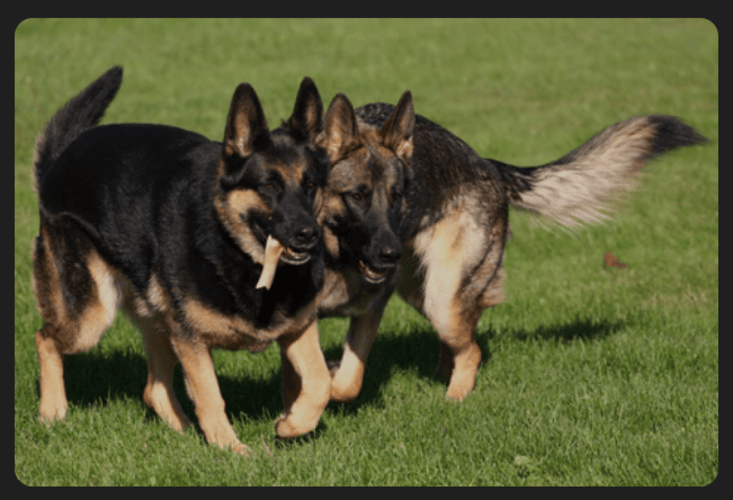
The Problems Jumping Causes
It might seem harmless when your GSD is young, but jumping creates real problems:
Safety risks — A full-grown German Shepherd can easily knock over children, elderly people, or anyone not expecting 70-80 pounds of dog to hit them.
Guest anxiety — Many people are uncomfortable around large dogs, and a jumping GSD can be genuinely frightening—even if you know your dog is friendly.
Damaged relationships — Visitors may stop coming over. Dog-sitter options become limited. Your social life suffers.
Reinforced bad habits — The longer jumping continues, the harder it becomes to break. Adult GSDs who’ve been jumping for years require more effort to retrain.
Injury to your dog — If someone reacts poorly (kneeing, pushing hard, or yelling), your dog could get hurt or develop anxiety around strangers.
The good news? With the right approach, even dogs who’ve been jumping for years can learn calm greetings.
What NOT to Do When Your GSD Jumps
Before we dive into what works, let’s clear up some harmful training methods that are still floating around online:
Don’t Knee Them in the Chest
This outdated advice can seriously hurt your dog—especially puppies or dogs with joint issues. It also damages trust and can create fear-based reactions.
Don’t Yell or Use Intimidation
Shouting “NO!” or using harsh corrections might stop the jumping temporarily, but it doesn’t teach your dog what to do instead. It also adds stress and confusion to an already excited moment.
Don’t Completely Ignore the Behavior
Some owners think ignoring jumping means doing absolutely nothing. But if your dog is still jumping all over guests while you stand there passively, you’re not addressing the problem—you’re just letting it continue.
The key is to remove the reward (attention) while teaching an alternative behavior. We’ll cover exactly how to do that next.
Don’t Give Up Too Soon
Consistency is everything. If you work on this for three days and then go back to old habits when you’re tired or in a hurry, your GSD will learn that jumping sometimes works— and they’ll keep trying.
The Foundation: Building Calm Greetings
Before we get into specific techniques, here’s the core principle that makes everything else work:
Your German Shepherd needs to learn that calm behavior—not jumping—is what earns attention, affection, and excitement.
That means:
- Jumping = no attention, no eye contact, no touching
- Four paws on the floor = praise, treats, petting, everything they want
It sounds simple, but it requires discipline from you and everyone your dog interacts with. Let’s break down exactly how to make this happen.
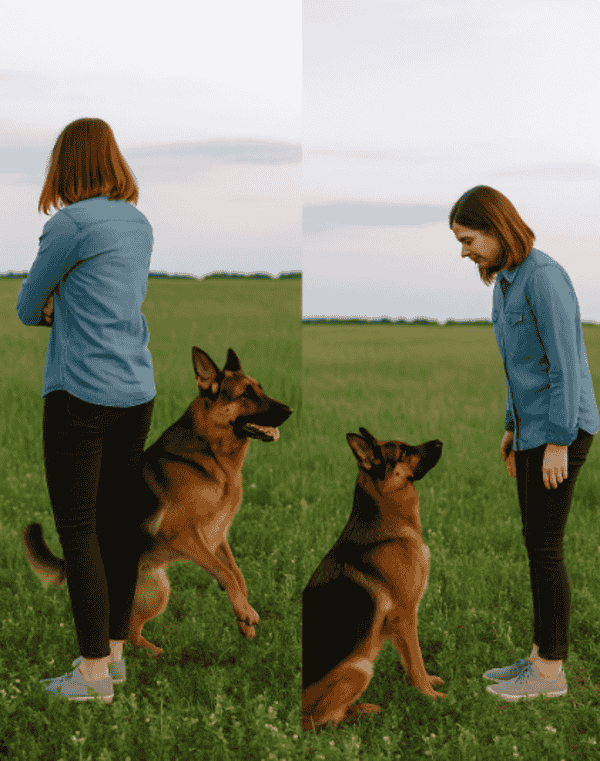
Step-by-Step Training: 10 Proven Techniques
1. Stay Calm and Remove the Reward
This is the foundation of everything else. Every time your German Shepherd jumps, your job is to immediately stop being interesting.
How to do it:
- The moment your dog jumps, turn your body away
- Cross your arms over your chest
- Look at the ceiling or away from your dog
- Stay completely silent—no words, no sounds
- Wait
The instant all four paws hit the ground, immediately turn back, make eye contact, and calmly say “yes” or “good.” You can offer a treat or gentle petting as a reward.
If your dog jumps again (they will), repeat the process. Turn away, go silent, wait for four paws, then reward.
Why it works:
Dogs repeat behaviors that get them what they want. If jumping earns nothing and calm earns everything, they’ll quickly shift their strategy.
Hazel’s Method:
With Rex, this felt endless at first. He’d jump, I’d turn away, he’d jump again, I’d turn away— over and over. But after three days of absolute consistency, something clicked. He started sitting automatically when I came home, just to get that faster reward. It was like watching a light bulb turn on.
2. Teach an Alternative Greeting Behavior
Instead of only focusing on “don’t jump,” teach your GSD what to do instead. The best alternative? Sitting for greetings.
How to train “Sit for Greetings”:
- Practice when there’s no excitement — Start in a calm environment with no distractions. Ask your dog to sit, then reward immediately.
- Add the doorway element — Practice having your dog sit when you approach the door (even when not leaving). Reward heavily for staying seated.
- Introduce mock arrivals — Go outside, wait 10 seconds, then come back in. If your dog jumps, turn away. If they sit (or you can quickly cue “sit”), reward immediately.
- Gradually increase excitement — Make your arrivals slightly more energetic each time, but still require the sit before any greeting happens.
- Bring in helpers — Have family members or friends practice the same routine. Your dog needs to learn this works with everyone, not just you.
Key tip: Ask guests to completely ignore your GSD until they’re sitting calmly. No eye contact, no talking, no touching until that behavior is offered.
This builds a powerful habit: “Sitting gets me what I want from every person I meet.”
3. Use a Leash for Controlled Greetings
Leash training isn’t just for walks—it’s one of the most effective tools for managing greetings at home.
How to use it:
When guests arrive or when you’re practicing greetings:
- Put your GSD on a standard 6-foot leash
- Step on the leash about 2 feet from the collar—this creates just enough slack for your dog to stand or sit comfortably, but not enough to jump
- Let your dog try to jump (they will)
- The leash naturally prevents it—without you having to physically intervene
- The moment they stop pulling and relax, praise and reward
- Gradually invite the guest closer, rewarding calm body language
Why it works:
The leash provides a physical boundary without you having to grab, push, or manhandle your dog. Your GSD learns that pulling and jumping don’t work, but staying calm does.
Practice this daily until your dog automatically stays grounded during greetings, even without the leash.

4. Practice the “Four Paws on the Floor” Rule
This is a household rule that everyone must follow religiously: No one gives your German Shepherd attention unless all four paws are on the floor.
That means:
- No petting if they’re jumping
- No talking to them while they’re jumping
- No eye contact during jumping
- No treats, toys, or play until they’re calm
Why strict consistency matters:
If one family member sometimes pets the dog while they’re jumping, or if guests occasionally give in because “it’s just so cute,” you’re training your GSD that jumping sometimes works—which means they’ll keep trying.
Think of it like a slot machine. If a behavior occasionally pays off, your dog will keep pulling that lever hoping for the jackpot.
The VCA Animal Hospitals training guide emphasizes that uniform responses across all family members help dogs learn faster and feel more secure in their understanding of expectations.
5. Manage Excitement Levels Before Guests Arrive
A hyper, overstimulated German Shepherd is far more likely to jump than a calm, tired one. Set your dog up for success by managing their energy before the exciting event happens.
Pre-guest routine:
30-60 minutes before guests arrive:
- Take your GSD for a brisk walk or jog
- Play fetch or tug-of-war
- Do a quick training session (sit, down, stay)
- Offer a puzzle toy or Kong to keep them occupied
The goal is to take the edge off that excitement so your dog can actually focus and make good choices when the doorbell rings.
During the arrival:
- Keep your dog on leash
- Cue “sit” before opening the door
- Reward calm behavior heavily
- If your dog breaks the sit, close the door and reset
Over time, this routine becomes second nature for both you and your dog. The mere act of guests arriving will trigger the calm, controlled greeting response.
6. Avoid Rough Play That Encourages Jumping
Play style matters. If your German Shepherd’s favorite games involve jumping, pawing, or wrestling, you’re accidentally reinforcing the exact behavior you’re trying to stop.
Games to avoid or modify:
- “Stand-up wrestling” where your dog puts paws on you
- Encouraging your dog to jump for toys or treats
- Roughhousing that involves a lot of physical contact while your dog is on hind legs
Better alternatives:
- Fetch — Burns energy and keeps four paws on the ground
- Tug-of-war with rules — Teach “take it” and “drop it” so the game has structure
- Scent games — Hide treats and let your dog use their nose
- Obedience-based play — Reward sits, downs, and stays with play as the reward
These games channel energy into focus and self-control instead of wild, unstructured excitement.
7. Teach the “Off” Command Gently
“Off” is different from “down.” It means “get your paws off of me/that surface/that person.”
How to teach it:
- Wait for your dog to jump (or lure them into jumping by acting excited)
- The moment their paws leave the ground, say “Off” in a calm, clear voice
- Turn your body away and go silent
- The instant all four paws hit the floor, say “Yes!” and reward
- Repeat this 10-15 times per training session
Key points:
- Say “Off” only once—don’t repeat it
- Keep your tone neutral, not angry
- The reward happens immediately when paws touch the ground
- Practice in short sessions multiple times a day
Eventually, your dog will hear “Off” and immediately return to the ground, knowing that’s where the good stuff happens.
The ASPCA training experts recommend this cue as part of positive reinforcement training for jump-prone breeds.
8. Reinforce Calm Behavior with Guests
Your guests are part of your training team, whether they know it or not. Educate them on how to interact with your German Shepherd.
Before guests arrive, send a quick text:
“Hey! We’re working on teaching [dog’s name] not to jump. When you arrive, please ignore them completely until they’re sitting calmly—no eye contact, talking, or touching. I’ll let you know when it’s okay to greet them. Thanks for helping us out!”
During the visit:
- Keep your dog on leash if needed
- Reward your GSD heavily for staying calm near guests
- If your dog jumps on a guest, have the guest immediately turn away and go silent
- Once your dog sits, the guest can calmly say hello
Why this works:
Your German Shepherd learns that the rule applies to everyone—not just you. Calmness earns greetings from all humans, and jumping earns nothing from anyone.

9. Reward the Quiet Moments
This is where most owners drop the ball. We’re quick to correct bad behavior, but we forget to praise the good stuff when it’s happening naturally.
Catch your GSD being calm:
- Lying quietly while you’re cooking dinner? Toss them a treat.
- Sitting politely while you put their leash on? Verbal praise.
- Staying grounded when someone walks past the window? Mark it with a “yes” and a reward.
You’re teaching your dog: “This calm, settled behavior is exactly what I love to see.”
Over time, calmness becomes your German Shepherd’s default state—not because they’re suppressing excitement, but because calm behavior has been so consistently rewarded that it feels natural.
Hazel’s favorite trick:
I keep a small treat pouch on my kitchen counter. Anytime I notice my GSD being calm —even if he’s just lying on his bed — I grab a treat and quietly reward her. He learned that being chill can get random rewards all the day, so he set’s to that behavior more and more.
10. Be Patient — Progress, Not Perfection
Training takes time, especially if your German Shepherd has been jumping for months or years. Don’t expect overnight miracles.
What realistic progress looks like:
Week 1-2: Your dog still jumps frequently, but you’re staying consistent with turning away and rewarding four-paws behavior. You might see small improvements — maybe they settle faster or jump less intensely.
Week 3-4: Your dog starts to “get it.” They might hesitate before jumping, or sit automatically more often. Guests still trigger excitement, but recovery time is faster.
Week 5-8: Jumping becomes the exception, not the rule. Your GSD greets you calmly most of the time and only occasionally forgets with new visitors.
Month 3+: Calm greetings are the new normal. Your dog might still get excited with highly stimulating situations, but they recover quickly and respond to cues.
Key reminders:
- Every dog learns at their own pace
- Puppies and young dogs may take longer
- Consistency is more important than speed
- Setbacks are normal—don’t give up
If you stay steady, patient, and consistent, you will see progress. Trust the process.
Troubleshooting: When Your GSD Won’t Stop Jumping
Sometimes, despite your best efforts, progress stalls. Here’s how to troubleshoot common issues:
Problem: “My dog jumps on everyone except me.”
Solution: Other people aren’t following the rules. Your dog has learned that jumping works with strangers, guests, or certain family members.
Fix it: Advice everyone your dog interacts with. Give the same instructions to all visitors, and practice controlled greetings with friends who are willing to help train.
Problem: “My dog is too strong—I can’t turn away fast enough.”
Trick : Use the leash method. Step on the leash to prevent jumping while you work on the training foundation. As your dog learns, you can phase out the leash.
Problem: “My GSD jumps during walks when we meet people.”
Trick :
- See people approaching from a distance
- Stop walking and ask your dog to sit before the person reaches you
- If they can’t sit calmly, create more distance—cross the street or step off the path
- Reward your dog heavily for sitting while the person passes
- Gradually decrease the distance as your dog improves
Practice makes perfect. The more successful calm greetings your dog experiences on walks, the more automatic it becomes.
Problem: “Training was going well, then suddenly my dog regressed.”
Answer : Regression is normal, especially during adolescence (6-18 months). Don’t panic. Go back to basics—more structure, more rewards, more consistency. Adolescent GSDs test boundaries, but if you stay firm, they’ll come back around.
Problem: “I’ve tried everything and nothing works.”
Answer : It might be time to bring in a professional. A certified dog trainer or veterinary behaviorist can observe your dog in person, identify what’s going wrong, and create a customized plan.
Consider professional help if:
- Your dog’s jumping is escalating or becoming aggressive
- You’ve been consistent for 8+ weeks with no improvement
- Your dog shows anxiety or fear alongside the jumping
- You feel overwhelmed or unsure how to proceed
There’s no shame in getting expert help. Sometimes a fresh set of eyes makes all the difference.
Age-Specific Training Tips
Training Puppies (8 weeks – 6 months)
Good news is : Puppies are learning sponges. If you start early, you can prevent jumping from ever becoming a deeply ingrained habit.
Focus on:
- Teaching “sit” as the default greeting behavior from day one
- Socializing your puppy with calm, polite greetings to many different people
- Keeping greetings low-key—don’t let visitors get your puppy overly excited
- Using positive reinforcement heavily (puppies respond beautifully to treats and praise)
Be patient: Puppies have short attention spans and boundless energy. Training sessions should be brief (5-10 minutes) but frequent (3-5 times daily).
Training Adolescent GSDs (6 months – 2 years)
Challenge: Adolescence is like the teenage years for dogs. Your previously well-behaved puppy might suddenly “forget” everything they learned and test every boundary.
Focus on:
- Increasing exercise significantly—adolescent GSDs have massive energy levels
- Going back to basics if needed—don’t be embarrassed to revisit foundation training
- Staying patient and consistent even when it feels like you’re moving backward
- Using high-value rewards (real chicken, cheese, etc.) to keep motivation high
Remember: This phase is temporary. Adolescent regression is normal and doesn’t mean your training failed.
Training Adult GSDs (2+ years)
Challenge: Adult dogs who’ve been jumping for years have deeply ingrained habits. Retraining takes longer, but it’s absolutely possible.
Focus on:
- Extreme consistency—no exceptions, no shortcuts
- Managing the environment (leash, controlled greetings, limited guest interactions at first)
- Patience—adult dogs can take 2-3 months to break old habits
- Celebrating small wins—every moment of calm progress deserves recognition
Don’t give up. Even senior dogs can learn new behaviors with the right approach.
How Long Does Training Take?
This is the question everyone asks, and the honest answer is: it depends.
Factors that affect training speed:
- Your dog’s age (puppies learn faster than adults)
- How long they’ve been jumping (longer history = longer to fix)
- Your consistency (100% consistency = faster results)
- Your dog’s energy level and personality
- How many people are involved in training
- Environmental factors (busy household vs. quiet home)
General timeline:
Puppies: 2-4 weeks of consistent training
Adolescents: 4-8 weeks
Adults with long-term habits: 8-12 weeks or more
The key is consistency. A dog trained with 100% consistency for 4 weeks will progress faster than a dog trained inconsistently for 6 months.
Real-Life Success Story: Rex’s Transformation
When I first adopted Rex at 8 months old, he was a jumping machine. Every person who walked through my door got the full-body launch treatment. My mom stopped visiting. My friends made excuses.
I tried everything—yelling “no,” pushing him down, even the (terrible) advice about kneeing him in the chest. Nothing worked, and I was exhausted.
Then I started working with a trainer who taught me the principles I’m sharing with you. It wasn’t complicated. Just turn away when he jumps, reward four paws on the floor, and teach “sit” for greetings. But it required absolute consistency.
For the first two weeks, I felt like a robot. Turn away. Wait. Reward. Turn away. Wait. Reward. Over and over and over.
Then, one morning, I came downstairs and Rex sat automatically at the bottom of the stairs, tail wagging, waiting for me to say good morning. No jumping. Just a polite, happy sit.
Tears came to my eyes.
From that point on words progress was fast. Within six weeks, he was greeting guests calmly. Within three months, even the most exciting visitors didn’t trigger jumping.
Today, Rex is four years old, and people constantly compliment his polite manners. He greets everyone — kids, elderly neighbors, delivery drivers — with a calm sit and a wagging tail.
If Rex can learn, your German Shepherd can too.

Finally
Jumping isn’t bad manners — it’s just enthusiasm looking for direction. Your German Shepherd isn’t trying to misbehave or disrespect you. They’re excited, social, and haven’t yet learned the polite way to express those feelings.
With consistency, patience, and positive reinforcement, you can transform those chaotic greetings into calm, confident moments that make you proud.
Your GSD wants to please you — they originally do. All you have to do is show them how to in a way they can understand.
Stay steady. Trust the process. Celebrate the small wins. And remember: progress, not perfection.
You’ve got this. And so does your German Shepherd.
Want more training success?
Lets learn how to build calm, confident behavior in every situation with our 10 Proven Training Tips for German Shepherd Puppies — perfect for dogs of any age who need foundation work.
More German Shepherd Training Guides
- Why Is My German Shepherd So Clingy? 7 Reasons + What to Do — Understanding attachment and anxiety
- German Shepherd Shedding: Complete Survival Guide — Grooming tips for calmer, cleaner dogs
- Best Food for German Shepherds — Nutrition that supports calm behavior
Browse all our training guides →
Trusted Resources
- American Kennel Club — Obedience Training Basics
- Positive Reinforcement Training Guide — PetMD
- How to Stop Your Dog From Jumping Up on People — AKC
- VCA Animal Hospitals — Puppy Training Basics
- ASPCA — Common Dog Behavior Issues
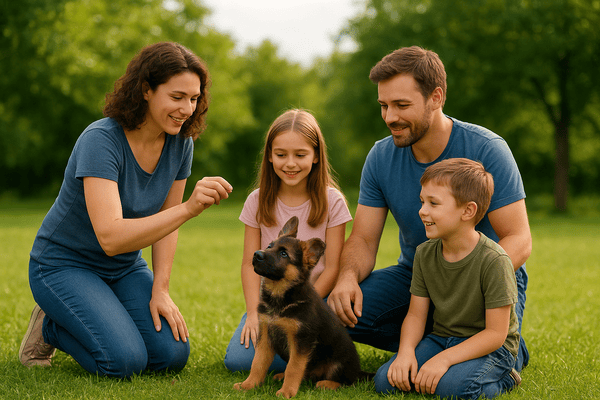
Has your German Shepherd struggled with jumping? What finally worked for you? Share your experience in the comments below—other GSD owners would love to hear your story!