

By Hazel Sloane
Complete German Shepherd growth chart from puppy to adult—average weight, height expectations, and when GSDs stop growing at every age.
When I brought home my first German Shepherd puppy, Luna, at 8 weeks old, she weighed just 16 pounds and fit in my arms. I remember wondering: how big will she actually get? Will she be 60 pounds or 90? When will she stop growing?
Fast forward two years, and Luna weighs a solid 72 pounds—right in the middle of the female German Shepherd range. But getting there wasn’t a straight line. Some months she grew so fast I could barely keep up with her food needs. Other months, growth seemed to stall completely.
Understanding German Shepherd size, growth patterns, and what’s normal at each stage takes the guesswork out of raising a healthy GSD. Whether you’re trying to predict your puppy’s adult size, concerned about growth rate, or just curious about breed standards, this complete guide covers everything you need to know.
German Shepherd Size Overview: The Basics
German Shepherds are classified as a large breed with significant size differences between males and females.
Average Adult Size
Males:
- Height: 24-26 inches at the shoulder
- Weight: 65-90 pounds
- More muscular and stocky build
Females:
- Height: 22-24 inches at the shoulder
- Weight: 50-70 pounds
- Slightly leaner and more refined build
Important note: These are breed standard ranges. Individual German Shepherds may fall slightly outside these ranges and still be perfectly healthy. Genetics, breeding lines, nutrition, and overall health all influence final adult size.
German Shepherd Growth Chart by Age
This chart shows average weight ranges for German Shepherd puppies at each stage of development. Use this as a general guideline, not an exact predictor.
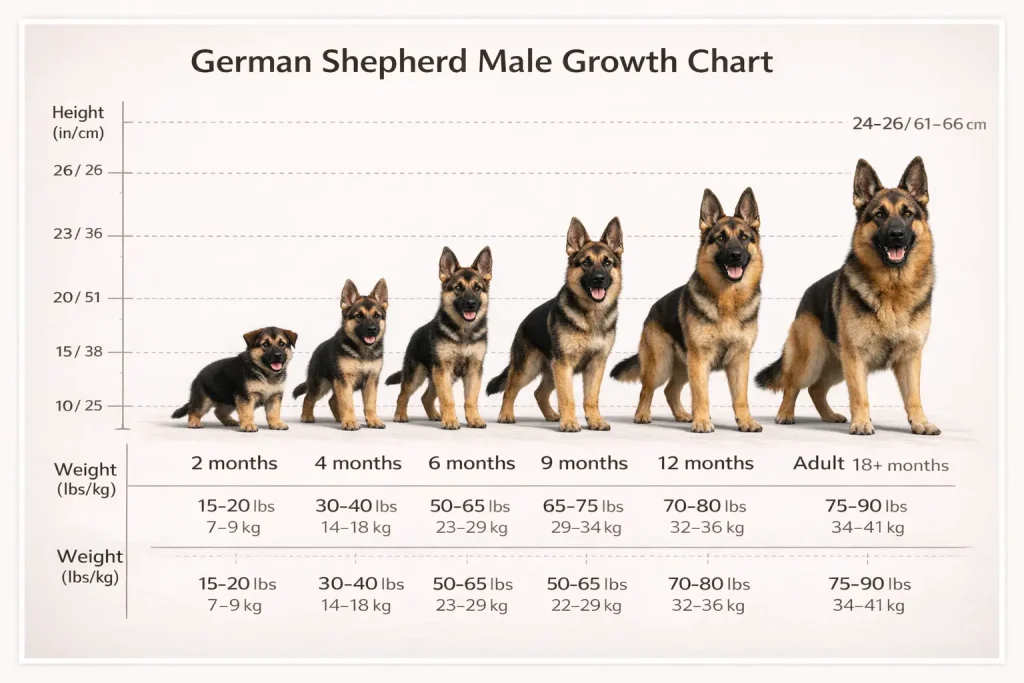
Growth Chart: Male German Shepherds
| Age | Weight Range | Height at Shoulder |
|---|---|---|
| 1 month | 5.5-9 lbs | 4-6 inches |
| 2 months | 16-20 lbs | 7-9 inches |
| 3 months | 26-32 lbs | 9-11 inches |
| 4 months | 35-45 lbs | 11-14 inches |
| 5 months | 45-55 lbs | 14-16 inches |
| 6 months | 53-64 lbs | 16-19 inches |
| 7 months | 57-68 lbs | 19-20 inches |
| 8 months | 60-71 lbs | 20-22 inches |
| 9 months | 63-75 lbs | 21-23 inches |
| 10 months | 66-78 lbs | 22-24 inches |
| 11 months | 67-80 lbs | 22-24 inches |
| 12 months | 68-82 lbs | 22-24 inches |
| 18 months | 70-85 lbs | 23-25 inches |
| 2-3 years | 65-90 lbs | 24-26 inches (fully grown) |
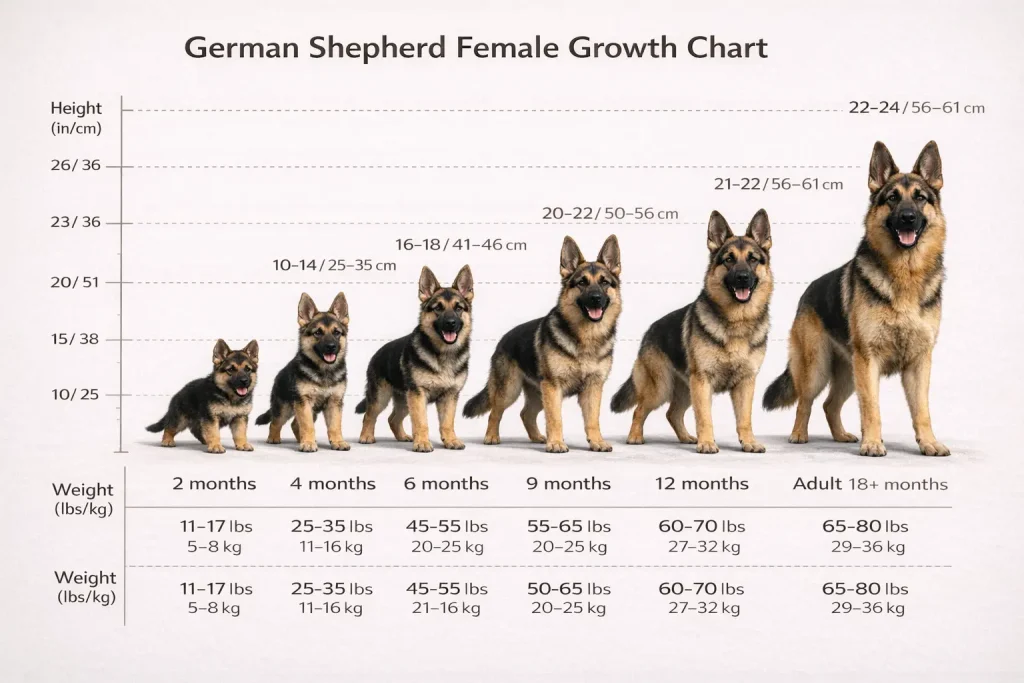
Growth Chart: Female German Shepherds
| Age | Weight Range | Height at Shoulder |
|---|---|---|
| 1 month | 4.5-8 lbs | 3-6 inches |
| 2 months | 11-17 lbs | 6-9 inches |
| 3 months | 22-30 lbs | 8-10 inches |
| 4 months | 31-40 lbs | 10-12 inches |
| 5 months | 38-49 lbs | 12-14 inches |
| 6 months | 44-55 lbs | 15-17 inches |
| 7 months | 48-59 lbs | 17-19 inches |
| 8 months | 51-63 lbs | 18-20 inches |
| 9 months | 53-66 lbs | 19-21 inches |
| 10 months | 55-68 lbs | 19-21 inches |
| 11 months | 57-70 lbs | 20-22 inches |
| 12 months | 58-70 lbs | 20-22 inches |
| 18 months | 60-70 lbs | 21-23 inches |
| 2-3 years | 50-70 lbs | 22-24 inches (fully grown) |
Remember: These are averages. Your GSD may grow faster or slower and still be perfectly healthy. What matters more than exact numbers is consistent, steady growth and overall body condition.
When Do German Shepherds Stop Growing?
This is one of the most common questions GSD owners ask, and the answer isn’t as simple as a single age.
Height Growth (Reaches Full Height First)
Males: Typically reach full height by 12-18 months
Females: Typically reach full height by 12-16 months
Once your GSD reaches their adult height, they won’t get any taller. The growth plates in their long bones close, ending vertical growth.
Weight and Muscle Development (Continues Longer)
Males: Continue filling out and adding muscle until 2-3 years old
Females: Continue filling out until 2-2.5 years old
Even after reaching full height, German Shepherds continue to gain weight as they develop muscle mass and their chest deepens. A 15-month-old male might be his full height but still look lanky compared to his appearance at 2.5 years when he’s fully filled out.
Full Physical Maturity
Complete maturity: 2-3 years old for both sexes
This is when your German Shepherd is considered fully grown—not just in height, but in muscle development, bone density, and overall physical structure.
Hazel’s Experience:
Luna reached her full height of 24 inches by about 14 months, but she continued filling out and gaining muscle until she was nearly 2.5 years old. At 18 months, she looked like a tall, skinny teenager. By 2.5 years, she’d developed into a strong, well-proportioned adult.
Factors That Affect German Shepherd Size
Not all German Shepherds end up the same size, even with the same parents. Multiple factors influence adult size.
1. Genetics (Primary Factor)
Parental size is the biggest predictor of puppy size. If both parents are on the larger end of the breed standard, their puppies likely will be too.
Bloodline matters:
- Working line GSDs tend to be slightly smaller and more compact
- Show line GSDs tend to be larger with more bone structure
- American vs. European lines show size variations
How to predict adult size:
Look at the parents. Your puppy will likely fall somewhere between the mother’s and father’s size, though males typically match or exceed the father’s size, and females typically match or exceed the mother’s size.
2. Nutrition During Growth
Proper nutrition supports optimal growth:
- Large breed puppy food controls growth rate (prevents too-fast growth)
- Adequate protein supports muscle development
- Balanced calcium/phosphorus ratios support healthy bones
Over-nutrition problems:
Feeding too much or using high-calorie food causes puppies to grow too fast, increasing hip dysplasia risk and joint problems.
Under-nutrition problems:
Insufficient food prevents puppies from reaching genetic size potential and can cause developmental issues.
The goal: Steady, controlled growth not maximum size or fastest growth.
3. Sex (Males vs. Females)
Males are consistently larger than females in both height and weight. This size difference is evident even in puppyhood and becomes more pronounced as dogs mature.
Typical difference: Males are 10-20 pounds heavier and 2-3 inches taller than females at maturity.
4. Spay/Neuter Timing
Early spay/neuter (before 6 months) can result in:
- Slightly taller adult height (growth plates stay open longer)
- Lankier build with less muscle mass
- Increased risk of joint problems
Later spay/neuter (after 12-18 months) allows:
- Growth plates to close naturally
- Normal muscle development
- Body proportions that match breed standard
Most veterinarians now recommend waiting until at least 12 months for large breed dogs like German Shepherds, though individual circumstances vary.
5. Health and Medical Issues
Conditions that can stunt growth:
- Parasites (worms rob nutrients needed for growth)
- Chronic illness during puppyhood
- Severe nutritional deficiencies
- Hormonal imbalances
Early treatment of health issues ensures puppies can reach their genetic potential.
6. Exercise During Growth Period
Moderate exercise supports healthy growth:
- Controlled leash walks
- Free play on soft surfaces
- Swimming
Excessive exercise harms growing joints:
- Forced running or jogging before 18 months
- Repetitive jumping (on/off furniture, agility)
- Long-distance hiking before maturity
The balance: Enough activity to build healthy muscles without damaging developing joints and bones.
How to Tell If Your German Shepherd Is the Right Size
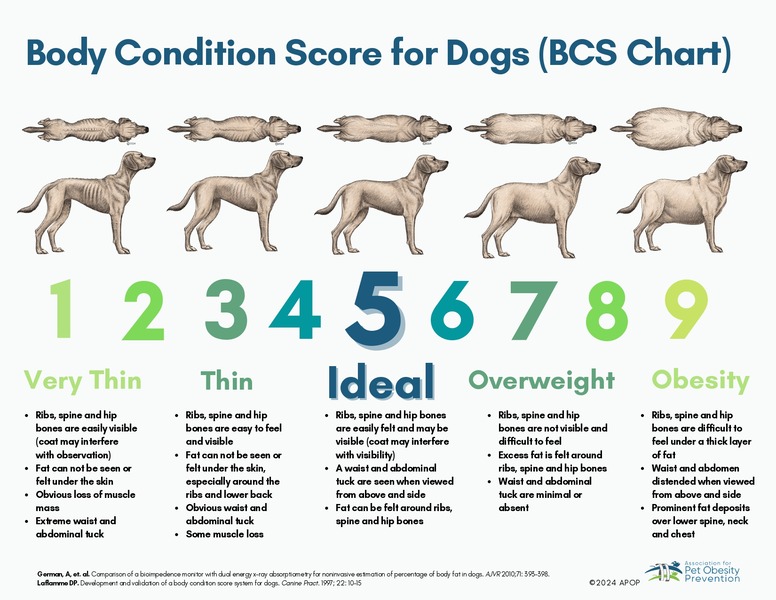
Numbers on a scale don’t tell the whole story. Body condition matters more than weight alone.
Ideal Body Condition for German Shepherds
When viewed from above:
- Clear waist behind the ribs
- Hourglass shape (not straight from shoulders to hips)
When viewed from the side:
- Abdominal tuck (belly slopes up from chest to hips)
- Not sagging or hanging
When you touch their sides:
- Ribs easily felt but not visibly protruding
- Slight fat covering over ribs
- Spine felt but not prominent
Signs Your GSD Is Underweight
- Ribs, spine, and hip bones clearly visible
- No fat covering over bones
- Severe waist and abdominal tuck
- Loss of muscle mass
- Low energy levels
Action: Increase food portions gradually and consult your vet to rule out health issues.
Signs Your GSD Is Overweight
- Ribs difficult to feel under fat layer
- No visible waist when viewed from above
- No abdominal tuck; belly hangs down
- Fat deposits at tail base and shoulders
- Difficulty breathing or moving
Action: Reduce food portions by 10-20%, increase exercise, and consult your vet for a weight loss plan. Obesity severely impacts joint health and overall wellbeing in German Shepherds.
Monthly Weight Checks
Weigh your GSD monthly to track growth patterns and catch problems early. For puppies, weekly weigh-ins help ensure steady growth. For adults, monthly checks help maintain ideal weight.
Hazel’s Method:
I weigh myself, then weigh myself holding Luna, and calculate the difference. It’s not perfect, but it’s close enough for tracking trends. For puppies, a luggage scale works great.
Working Line vs. Show Line Size Differences
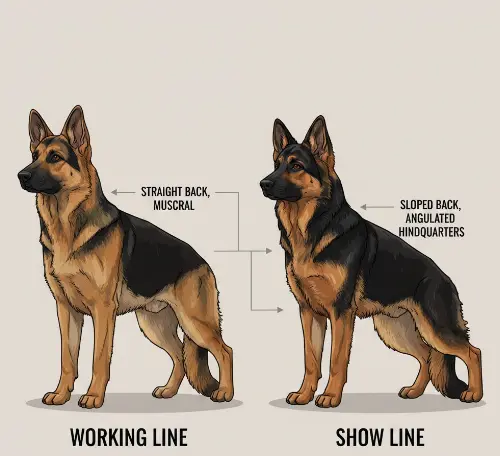
German Shepherds bred for different purposes show size variations.
Working Line German Shepherds
Characteristics:
- Slightly smaller and more compact
- Males: 60-75 pounds, Females: 45-60 pounds
- More athletic, less angulation
- Bred for function over appearance
Why they’re smaller:
Working dogs need endurance, agility, and efficiency. Extra size adds weight without improving working ability, so working lines have been selectively bred for optimal performance size.
Show Line German Shepherds
Characteristics:
- Larger, heavier bone structure
- Males: 75-90 pounds, Females: 55-70 pounds
- More angulation, sloped topline
- Bred to meet conformation standards
Why they’re larger:
Show standards favor substantial bone, size, and presence. Show line breeders select for dogs that command attention in the ring.
Which is healthier?
Neither is inherently healthier based on size alone, though working lines’ straighter backs may reduce some joint stress. Health depends more on breeding practices, genetic testing, and individual care than size category.
Size Comparison: German Shepherds vs. Other Breeds
Understanding GSD size in context helps prospective owners know what to expect.
Larger than German Shepherds:
- Rottweiler: 80-135 pounds
- Great Dane: 110-175 pounds
- Mastiff: 120-230 pounds
Similar size to German Shepherds:
- Labrador Retriever: 55-80 pounds
- Golden Retriever: 55-75 pounds
- Belgian Malinois: 40-80 pounds
Smaller than German Shepherds:
- Border Collie: 30-55 pounds
- Australian Shepherd: 40-65 pounds
- Beagle: 20-30 pounds
Why this matters:
German Shepherds are large dogs requiring space, appropriate vehicles, larger gear, and the physical ability to handle a strong, active 65-90 pound animal.
How to Predict Your Puppy’s Adult Size
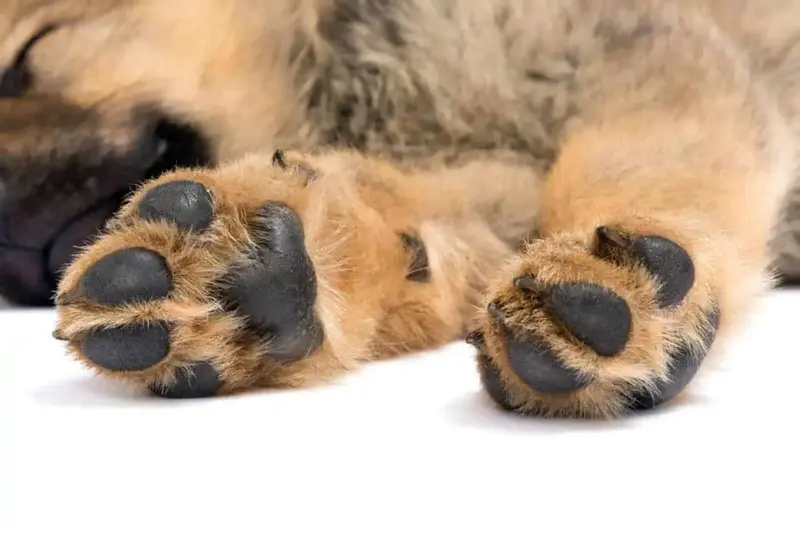
While you can’t know exactly, these methods give reasonable estimates.
Method 1: Paw Size
Large paws relative to body often indicate a larger adult dog. Puppies grow into their paws, so oversized puppy paws suggest significant growth ahead.
Limitation: Not scientifically precise, but a useful general indicator.
Method 2: Parental Size
Most reliable method:
- Males usually match or slightly exceed father’s size
- Females usually match or slightly exceed mother’s size
Ask the breeder for parent weights and heights if you purchased from a breeder.
Method 3: Weight at 3-4 Months
Rough estimate:
A puppy’s weight at 3-4 months is approximately half their adult weight.
Example:
- 30-pound male puppy at 3 months → approximately 60-70 pound adult
- 35-pound male puppy at 4 months → approximately 70-80 pound adult
Limitation: Individual variation means this is only a rough estimate.
Method 4: Growth Rate Observation
Fast-growing puppies (those consistently at the upper end of weight ranges) typically become larger adults.
Slower-growing puppies (those at the lower end of ranges) typically become smaller adults.
Track weekly or monthly weight and compare to the growth chart to see your puppy’s trend.
Common Size-Related Concerns
“My Puppy Seems Too Small”
When to worry:
- Puppy is significantly below the low end of weight range
- Not gaining weight consistently
- Appears lethargic or unhealthy
- Severe body condition (very thin, visible bones)
When not to worry:
- Puppy is active, energetic, and healthy
- Growing steadily even if on the smaller end
- Parents are smaller GSDs (genetics)
Action: If growth has stopped or puppy seems unwell, consult your vet.
“My Puppy Seems Too Big”
When to worry:
- Growing extremely fast (much faster than chart)
- Visibly overweight with no waist
- Limping or showing joint pain
- Being overfed high-calorie food
When not to worry:
- Large but proportional and healthy
- Parents are large GSDs
- Steady growth without sudden spikes
- Lean body condition despite size
Action: If puppy is overweight, reduce food by 10-20% and switch to large breed puppy formula.
“My GSD Stopped Growing Early”
Possible reasons:
- Reached genetic potential (some dogs mature earlier)
- Early spay/neuter affected growth
- Nutritional deficiency during growth
- Health issue impacting development
Action: If your GSD is healthy, active, and proportional, early maturity is fine. If concerned, consult your vet.
“My GSD Is Still Growing After 2 Years”
Normal in males:
Males can continue filling out and adding muscle until 2.5-3 years old. Height growth stops earlier, but weight can still increase.
Less common in females:
Females typically finish by 2-2.5 years, but late bloomers exist.
When to check with vet:
If your GSD continues gaining significant weight after 2.5 years, ensure it’s muscle (healthy) and not fat (concerning).
Maintaining Healthy Weight Throughout Life
Size at maturity is just the beginning. Maintaining ideal weight throughout your GSD’s life protects their health.
Puppy Stage (0-12 Months)
Goal: Controlled, steady growth
Feeding guidelines:
- Large breed puppy food only
- Follow package guidelines but adjust for body condition
- Avoid over-supplementing calcium
- Feed 3-4 meals daily until 6 months, then 2 meals
Monitor: Weekly weigh-ins, monthly body condition checks
Adult Stage (1-7 Years)
Goal: Maintain ideal weight and muscle mass
Feeding guidelines:
- High-quality adult dog food
- Adjust portions based on activity level
- Include joint supplements starting by age 2-3
Monitor: Monthly weigh-ins, watch for weight creep
Senior Stage (7+ Years)
Goal: Prevent obesity while maintaining muscle
Feeding guidelines:
- Senior formula or lower-calorie adult food if activity decreases
- May need fewer calories as metabolism slows
- Continue joint support supplements
- Maintain protein for muscle preservation
Monitor: Monthly weigh-ins, adjust quickly if weight increases
Hazel’s Approach:
Luna gets fed twice daily with portions adjusted based on her activity level. More hiking in summer means slightly more food. Less activity in winter means slightly less. I weigh her monthly and adjust immediately if I notice changes.
Size and Health Connections
German Shepherd size directly impacts certain health considerations.
Joint Health
Larger GSDs have more stress on joints, increasing arthritis and hip dysplasia risk. Maintaining lean body weight throughout life is crucial.
Every extra pound adds approximately four pounds of pressure on joints.
Lifespan Correlation
Smaller German Shepherds (within breed standard) tend to live slightly longer than very large ones. Size extremes at either end can indicate breeding issues.
Optimal size for longevity appears to be middle-of-the-range for the breed standard.
Heart Health
Very large GSDs have higher risk of dilated cardiomyopathy (DCM) and other heart issues. Proper nutrition and avoiding obesity protect heart health.
Final Thoughts
German Shepherd size is wonderfully varied within the breed standard, and every size brings something special. Luna, at 72 pounds, is perfect for my lifestyle—big enough to feel substantial but small enough to manage easily.
Whether your German Shepherd ends up 55 pounds or 90 pounds, what matters most is that they’re healthy, well-proportioned, and thriving. Focus less on reaching a specific number and more on maintaining ideal body condition, providing proper nutrition, and supporting healthy growth.
Your GSD’s size is largely determined by genetics, but you control the factors that ensure they reach their healthy potential: quality food, appropriate exercise, proper veterinary care, and lots of love.
Watch those growth charts as guidelines, not rigid rules. Celebrate your German Shepherd’s unique size, and remember that the best size for your GSD is the healthy, happy size they’re meant to be.
💡 Want to support healthy growth and development?
Learn about proper nutrition for German Shepherds and how diet impacts size, joint health, and overall wellbeing.
More German Shepherd Breed Guides
- Male vs. Female German Shepherds: Which Should You Choose? — Temperament and size differences
- German Shepherd Colors: Complete Guide to Coat Colors — All color variations explained
- Are German Shepherds Good Family Dogs? — Temperament and suitability
Explore all GSD breed facts →
Trusted Resources
- American Kennel Club — German Shepherd Breed Standard
- German Shepherd Dog Club of America — Official Breed Standard
- Ekanuba — Puppy Growth and Development
Keywords: German Shepherd size, GSD weight chart, German Shepherd growth chart, how big do German Shepherds get, German Shepherd height, when do German Shepherds stop growing
How big is your German Shepherd? Did they end up larger or smaller than you expected? Share your GSD’s size in the comments!