

By Hazel Sloane
Train your German Shepherd puppy the right way with these proven obedience tips — from essential commands to common mistakes every new GSD owner needs to know.
When I first brought my German Shepherd puppy home, I quickly realized how intelligent and stubborn these dogs can be. At eight weeks old, my pup was already testing boundaries, figuring out which family member would give in first, and showing flashes of the brilliant working dog she’d become.
GSDs are loyal, quick learners, and eager to please, but they also test your patience if training isn’t structured and carry on as same. I made plenty of mistakes in those early weeks rewarding behavior I didn’t mean to, being inconsistent with commands, and underestimating just how much mental stimulation a German Shepherd puppy needs.
The good news? Once I learned the right approach, everything changed. pupy went from chaos and confusion to a calm, obedient, and confident companion who genuinely loved training sessions.
These are the training tips that worked wonders for me — and they’ll help you build that same lifelong bond with your GSD puppy.
Why German Shepherd Puppies Need Special Training Attention
German Shepherds aren’t your average puppy. They’re bred to work, think, and problem-solve. That intelligence is a gift — but it also means they need structure, direction, and a confident leader from day one.
They’re Incredibly Smart (Which Can Be a Challenge)
A bored, under-stimulated GSD puppy will find their own “job”—and you probably won’t like what they choose. Chewing furniture, digging holes, barking excessively, or becoming overly protective are all signs of a puppy who doesn’t have enough mental and physical engagement.But we love it isnt it?
They Bond Deeply and Look for Leadership
German Shepherds are pack animals who thrive when they understand their role in the family. If you don’t establish yourself as a calm, consistent leader, your puppy will step into that dominance role and that’s when behavior problems start.
Early Training Shapes Adult Behavior
The habits you allow (or don’t allow) in puppyhood become the behaviors you live with for the next 10-12 years. A GSD puppy who’s never taught boundaries becomes an adult dog who’s been sadly difficult to manage.
The great news? German Shepherds want to please you. They’re more happier when they have clear expectations and consistent feedback. Let’s dive into exactly how to give them that feeling.
1. Start Training the Moment They Come Home
Don’t wait. Training should begin the very first day of your German Shepherd puppy steps into your home.
Why Early Training Matters
At eight weeks old, your puppy’s brain is like a sponge. They’re learning constantly to absorb everything. Whether you’re actively training them or not. If you wait weeks or months to start, you’re missing the easiest window for building good habits.
What to Teach First
House rules — Where they can and can’t go, where they sleep, what they can chew
Their name — Use it positively and reward when they respond
Simple commands — “Sit,” “come,” and “no” are your foundation
How to Structure Early Sessions
Keep training sessions short — 5 to 10 minutes max. Puppies have tiny attention spans, and pushing too long leads to frustration for both of you.
Always end on a win. If your puppy successfully sits once, celebrate that and stop. You want them to join training with fun and success, not exhaustion or confusion.
Hazel’s Tip:
I trained my pup three times a day in 5-minute bursts—morning, midday, and evening. It felt manageable for me and kept her engaged without overwhelming her.

2. Focus on Positive Reinforcement
German Shepherds thrive on praise and rewards. Harsh corrections, yelling, or physical punishment will backfire with this breed.
Why Positive Reinforcement Works
GSDs are sensitive and bond-driven. They genuinely want to make you happy. When you reward behavior you like, they’ll repeat it because it feels good and strengthens your connection.
Punishment, on the other hand, creates fear, anxiety, and confusion. A scared dog isn’t a well-trained dog—they’re just a dog who’s learned to avoid certain situations.
What Counts as a Reward
Treats — Small, high-value treats (real chicken, cheese, or quality training treats)
Praise — Enthusiastic verbal approval (“Yes! Good girl!”)
Play — A quick game of tug or fetch as a reward
Affection — Petting and physical contact
The Timing Rule
Rewards must happen immediately—within 1-2 seconds of the behavior. If you wait even five seconds, your puppy won’t connect the reward to what they just did.
Example:
Your puppy sits. You say “Yes!” and give a treat within one second. Your puppy’s brain makes the connection: Sitting = treat.
If you wait 10 seconds, your puppy might have stood up or looked away. Now they think standing or looking away earned the treat.
3. Master the Basic Commands
Before moving to advanced tricks, get the core commands trained in:
Command #1: Sit
Why it matters: “Sit” is the gateway command. It teaches impulse control and becomes the foundation for “stay,” “down,” and other behaviors.
How to teach it:
- Hold a treat close to your puppy’s nose
- Slowly move the treat up and back over their head
- Their rear will naturally lower to the ground
- The moment their butt touches down, say “Yes!” and give the treat
- Repeat 5-10 times per session
Common mistake: Saying “sit” multiple times. Say it once, then wait. If they don’t respond, guide them gently—don’t repeat the command.
Command #2: Come (Recall)
Why it matters: A solid recall can prevent your GSD from running into traffic, chasing wildlife, or getting lost.
How to teach it:
- Start indoors with no distractions
- Say your puppy’s name followed by “Come!”
- Back up a few steps to encourage movement toward you
- When they reach you, reward heavily (treats + praise)
- Practice daily, gradually adding distance and mild distractions
Pro tip: Never call your puppy to you for something they dislike (baths, nail trimming, leaving the park). You want “come” to always mean something good is about to happen.
Command #3: Stay
Why it matters: “Stay” teaches patience and self-control. It’s essential for managing your GSD in busy environments or when guests visit.
How to teach it:
- Ask your puppy to sit
- Hold your hand up in a “stop” gesture and say “Stay”
- Take one step back
- If they stay for even 2 seconds, return and reward
- Gradually increase the time and distance
Common mistake: Expecting too much too soon. Start with 2-3 seconds and build slowly.
Command #4: Down
Why it matters: “Down” is a calming command that helps your GSD settle in stimulating situations.
How to teach it:
- Start with your puppy in a sit
- Hold a treat in your closed hand at their nose level
- Slowly lower your hand to the ground
- Your puppy should follow the treat and lie down
- The moment their elbows touch the ground, say “Yes!” and reward
If they stand instead: Reset and try again. Some puppies need you to lure them under your bent leg or a low chair to understand the motion.
Command #5: Leave It
Why it matters: “Leave it” prevents your puppy from eating something dangerous, chasing animals, or grabbing things they shouldn’t.
How to teach it:
- Place a treat in your closed fist
- Let your puppy sniff, lick, and paw at your hand
- Wait. Don’t say anything.
- The moment they stop trying and pull back, say “Yes!” and give them a different treat from your other hand
- Repeat until they understand that ignoring the first treat earns a better reward
Progress slowly: Once they’ve mastered this with your hand, practice with treats on the floor, then with toys, and eventually with distractions during walks.
4. Keep Consistency Between Family Members
This is where many families fail—and it’s one of the biggest reasons puppies get confused and training stalls.
Why Consistency Matters
If one person lets your puppy on the couch while another scolds them for it, your GSD gets mixed messages. They don’t understand that rules change depending on who’s in the room—they just think the rules are unclear.
German Shepherds are observant and incredibly smart. They’ll quickly figure out which family member enforces rules and which one doesn’t. And they will test those boundaries.
How to Stay Consistent
Family meeting: Before your puppy arrives, everyone should agree on the rules. What’s allowed? What’s not? What commands will you use?
Same words, same tone: Everyone should use the exact same command words. If one person says “down” and another says “lie down,” your puppy won’t connect them as the same behavior.
Same consequences: If jumping isn’t allowed, everyone must turn away when the puppy jumps. No exceptions.
5. Leash Train with Patience
German Shepherds love to pull. They’re strong, energetic, and naturally want to lead the way. But a 70-pound adult GSD who pulls on the leash isn’t fun to walk—it’s dangerous.
Start Indoors First
Before you hit the sidewalk, practice leash walking inside your home where there are zero distractions.
- Put the leash on your puppy
- Let them drag it around for a few minutes to get used to the feeling
- Pick up the leash and walk around your living room
- Reward your puppy for staying near you
The “Red Light, Green Light” Method
This is the most effective technique for teaching loose-leash walking:
Green light: Your puppy walks calmly beside you with a loose leash = you keep moving forward
Red light: Your puppy pulls = you stop immediately and stand still
Don’t move forward again until the leash goes slack. The moment it does, praise your puppy and start walking again.
Why it works: Your puppy learns that pulling gets them nowhere, but walking calmly gets them where they want to go.
Use the Right Equipment
A front-clip harness can help discourage pulling because it redirects your puppy toward you when they pull forward.
Avoid retractable leashes during training—they teach puppies that pulling extends the leash, which is the opposite of what you want.
6. Socialize Early and Often
The period between 8 and 16 weeks old is your puppy’s critical socialization window. What they experience during this time shapes how they’ll respond to the world as an adult.
What Socialization Actually Means
Socialization isn’t just about meeting other dogs (though that’s part of it). It’s about exposing your puppy to:
Different environments — Parks, pet stores, sidewalks, parking lots, friend’s houses
Various sounds — Vacuum cleaners, traffic, thunderstorms, doorbells, kids playing
Different people — Men, women, children, people in hats or sunglasses, people using wheelchairs or canes
Other animals — Friendly dogs, cats (if possible), even seeing livestock from a distance
How to Socialize Safely
Keep experiences positive: If your puppy seems scared, don’t force them closer. Let them observe from a comfortable distance and reward calm behavior.
Go slow: One new experience per day is plenty. Overwhelming your puppy can backfire and create fear instead of confidence.
Avoid dog parks until fully vaccinated: Your puppy’s immune system isn’t fully developed yet. Stick to controlled socialization with healthy, vaccinated dogs you know.
Watch body language: A confident puppy has a loose, wiggly body and approaches new things with curiosity. A scared puppy tucks their tail, leans back, or tries to hide. Respect their comfort level.
Why This Matters for German Shepherds
GSDs are naturally protective and can become overly suspicious of strangers or new situations if not properly socialized. A well-socialized GSD is confident, calm, and able to distinguish between real threats and normal life.
7. Manage Their Energy Wisely
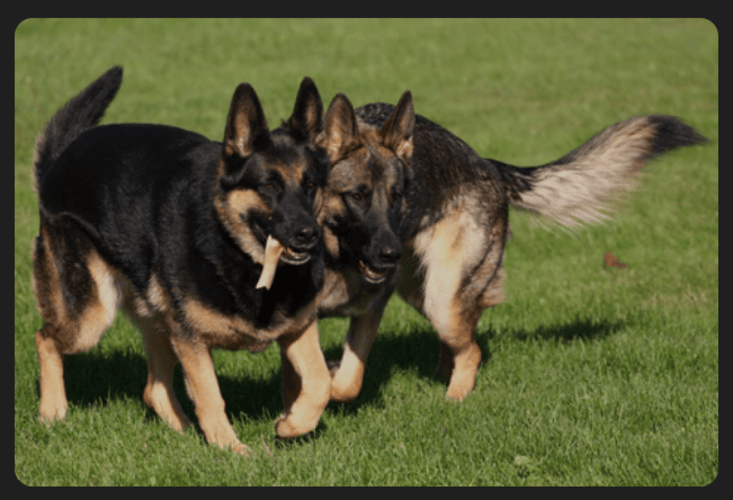
German Shepherd puppies have a lot of energy. If that energy doesn’t have an outlet, it turns into destructive behavior, hyperactivity, or difficulty focusing during training.
Physical Exercise
Age-appropriate activity: The general rule is 5 minutes of exercise per month of age, twice daily. So a 3-month-old puppy should get about 15 minutes of exercise, twice a day.
What counts:
- Short walks
- Fetch in the yard
- Tug-of-war
- Playing with other puppies
What to avoid:
- Long runs or hikes (hard on growing joints)
- Jumping on and off furniture repeatedly
- High-impact activities before 12-18 months old
Mental Stimulation (Just as Important as Physical Exercise)
A 10-minute training session can tire out your puppy as much as a 30-minute walk.
Mental exercise ideas:
- Training sessions (commands, tricks)
- Puzzle toys
- Hide-and-seek with treats
- Sniffing games (hide treats around the house)
- Frozen Kongs stuffed with peanut butter or yogurt
Hazel’s Go-To:
When Luna was a puppy, I’d hide small treats around the living room and let her “hunt” for them. It kept her busy for 15 minutes and completely wore her out mentally.
8. Avoid Overtraining
It’s tempting to keep training when your puppy is doing great, but pushing too hard can backfire.
Signs Your Puppy Is Overtrained
- Losing interest or walking away
- Getting frustrated or whiny
- Making mistakes they normally don’t make
- Becoming hyperactive or unable to focus
The Better Approach
Train in short bursts: 5-10 minutes is plenty for a young puppy. Three short sessions per day beats one 30-minute marathon.
End on success: Always finish with something your puppy does well. If they nail a “sit,” celebrate and stop. You want them to walk away feeling successful and excited for next time.
Build in rest days: If you’ve had several intense training days, give your puppy a break. Let them just be a puppy for a day.
9. Crate Train for Confidence and Structure
Potty training: Puppies instinctively avoid soiling their sleeping area. A properly sized crate speeds up housebreaking.
Safety: When you can’t supervise, the crate prevents destructive chewing, eating dangerous items, or getting into trouble.
Separation anxiety prevention: Puppies who learn to be comfortable alone in a crate are less likely to develop separation anxiety as adults.
Travel and vet visits: A crate-trained dog is easier to transport and less stressed at the vet or groomer.
How to Crate Train Properly
Make it inviting: Add a soft blanket, a safe chew toy, and maybe a piece of your worn clothing (your scent is comforting).
Never use it as punishment: The crate should only have positive associations.
Start slow: Let your puppy explore the crate with the door open. Toss treats inside. Feed meals inside.
Build duration gradually: Close the door for 30 seconds, then open it. Gradually increase the time as your puppy stays calm.
Ignore whining (within reason): If your puppy whines, wait for a moment of quiet before opening the door. You don’t want to teach them that whining = release.
Crate schedule: Puppies can hold their bladder for roughly one hour per month of age. A 3-month-old puppy shouldn’t be crated for more than 3-4 hours during the day.

10. Be Patient — Progress Takes Time
Every German Shepherd learns at their own pace. You’ll have days where everything clicks and others where it feels like you’re starting from scratch. That’s completely normal.
Realistic Timeline Expectations
8-12 weeks: Basic commands like sit, come, name recognition; crate training and potty training foundation
3-4 months: More reliable on basic commands; improving leash manners; better bladder control
5-6 months: Solidifying obedience; testing boundaries (adolescence begins)
6-12 months: Adolescent phase (expect some regression); continued reinforcement needed
12-18 months: Maturing into reliable obedience; still needs consistency
What Slows Progress
Inconsistency — Different rules from different people
Insufficient practice — Training once a week isn’t enough
Too many distractions too soon — Master skills at home before adding challenges
Impatience — Getting frustrated and giving up too quickly
What Speeds Progress
Daily short sessions — Consistency beats intensity
High-value rewards — Real chicken or cheese works better than dry kibble
Calm, confident energy — Your puppy mirrors your emotional state
Celebrating small wins — Every bit of progress deserves recognition
Hazel’s Perspective:
There were days when Luna seemed to forget everything we’d worked on. I’d get frustrated and wonder if I was doing something wrong. But I stayed consistent, kept sessions positive, and trusted the process. By six months, she was the best-trained puppy at our local park. It just took time.
Common Puppy Training Mistakes to Avoid
Even with the best intentions, it’s easy to make mistakes. Here are the ones I see most often:
Mistake #1: Repeating Commands
If you say “sit, sit, sit, sit,” your puppy learns they don’t have to respond until the fourth “sit.” Say it once, then wait or gently guide them.
Mistake #2: Training Only in One Location
Your puppy might sit perfectly in the living room but ignore you at the park. That’s because they haven’t generalized the command. Practice in different rooms, the yard, on walks, and at friends’ houses.
Mistake #3: Skipping Socialization
“My puppy is shy, so I’ll wait until they’re older.” No—waiting makes it worse. Gradual, positive exposure during the critical window is essential.
Mistake #4: Allowing “Just This Once” Behavior
“Just this once” doesn’t exist for puppies. If you let them on the couch once, they’ll try again. Boundaries must be consistent from day one.
Mistake #5: Using Training as Punishment
Never call your puppy to you and then scold them or do something they hate (like give medicine or trim nails). “Come” should always lead to something positive.
When to Consider Professional Help
Most puppy training can be done at home with consistency and patience, but sometimes professional guidance is worth it.
Consider a trainer if:
- Your puppy shows signs of aggression (growling, snapping, biting beyond normal puppy mouthing)
- You feel overwhelmed or don’t know where to start
- Your puppy has severe fear or anxiety issues
- You want to pursue advanced training (protection work, competition obedience, etc.)
- Group puppy classes are a great option for socialization and foundational skills
Training Tools Worth Having
You don’t need a lot of fancy equipment, but these basics make training easier:
Treat pouch — Keeps rewards accessible during training
High-value treats — Small, soft, and irresistible (real chicken, cheese, hot dog pieces)
6-foot leash — Standard length for training
Front-clip harness — Helps with pulling
Clicker (optional) — Marks exact moment of correct behavior
Interactive toys — Kongs, puzzle feeders, snuffle mats for mental stimulation

Final Thoughts
Training a German Shepherd puppy isn’t about dominance or control—it’s about communication, trust, and partnership.
Once you understand their intelligence, their need for structure, and their deep desire to work with you, everything becomes easier. Yes, they’ll test boundaries. Yes, they’ll have off days. But with consistency, patience, and positive reinforcement, you’ll shape your puppy into the confident, obedient, and loyal companion German Shepherds are famous for being.
Keep sessions fun. Celebrate progress. Be the calm, confident leader your puppy needs. And remember: a well-trained GSD isn’t just obedient—they’re a joy to live with, a devoted protector, and your best friend for life.
Want to tackle specific behavior challenges?
Check out our guide on How to Stop German Shepherds from Jumping on People for detailed training strategies beyond basic obedience.
More German Shepherd Training Guides
- Why Is My German Shepherd So Clingy? 7 Reasons + What to Do — Understanding attachment and separation anxiety
- German Shepherd Shedding: Complete Survival Guide — Grooming and coat care essentials
- Best Food for German Shepherds — Nutrition for training success
Browse all our GSD training resources →
Trusted Resources
- American Kennel Club — German Shepherd Training Guide
- VCA Animal Hospitals — Puppy Training Basics
- Pet MD — Positive Reinforcement Training
What’s the biggest training challenge you’ve faced with your GSD puppy? Share your experience in the comments—other owners would love to hear what worked (or didn’t work) for you!